The Sheath Is Half the Knife: Carrying a Small Fixed Blade That Disappears in City Clothes
Ask most guys why they don’t carry a fixed blade in the city and the answer is never really about the blade. It’s about the sheath, the printing, the awkward belt-line lump, and the vague worry that a full-tang knife is somehow “too much” for opening boxes and slicing an apple at your desk. That’s backwards. A small fixed blade is one of the most honest tools you can carry — no pivot to loosen, no lock to trust, no lint jamming a detent. The whole game is figuring out how to make three or four inches of steel ride comfortably and invisibly under normal clothes. Get the carry right and a fixed blade is easier to live with than the folder it replaces.
This is a field guide to doing exactly that: picking a small urban fixed blade by how it carries, then setting up the sheath so it disappears. We’ll get into specific models, real steel behavior, and the deployment positions that actually work when you’re standing at a kitchen counter or sitting in a car — not on a bushcraft blog’s idea of “the field.”
Why the Sheath Is the Real Purchase
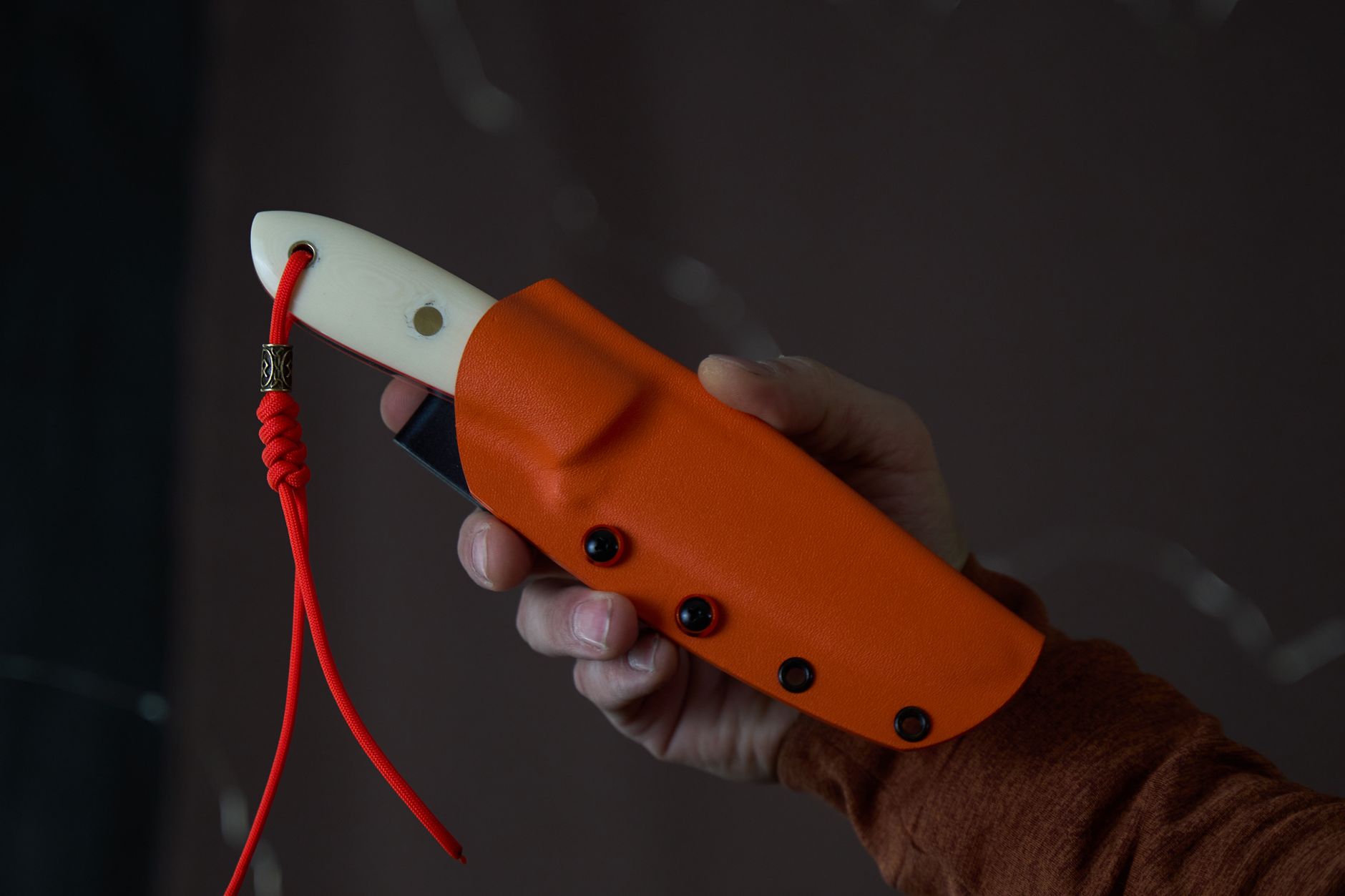
With a folder, the knife is the carry system — clip, detent, pocket. With a fixed blade you’re buying two objects that have to work together, and the sheath is the one that decides whether the knife ever leaves the drawer. A brilliant blade in a floppy leather pouch that flops around your waistband gets “drawer-retired” in a week. A mediocre blade in a well-set-up Kydex sheath with the right clip gets carried every day.
Kydex is the default for urban carry for good reasons. It’s thin, it retains the knife by friction and a molded click so nothing rattles, and it doesn’t soak up sweat the way leather does when the sheath rides against your body all day. The trade-off is noise on the draw and a hard shell that prints more sharply than soft leather. Leather is quieter, dresses nicer, and molds to your body over time, but it’s thicker, needs care, and a wet leather sheath against a carbon-steel blade is how you get rust. For a city knife that lives inside the waistband or in a pocket, Kydex or a hybrid Kydex-with-fabric-loop setup wins most of the time.
Retention, Clip, and the Printing Problem
Three sheath details make or break urban carry. Retention has to be strong enough that the knife won’t fall out when you bend, run for a bus, or take your jacket off — you want an audible click seating and a firm tug to draw. The clip determines where and how deep the knife rides; a soft loop or a Discreet Carry Concepts-style spring clip lets a sheath ride low and “deep cover” so only a small tab shows above the waistband. Printing is the shape pushing through your shirt — vertical carry along the belt line prints far less than a horizontal scout-carry sheath across the small of your back, which broadcasts a knife-shaped bulge every time you reach for your wallet.
The Blades Worth Building a Carry Around
A good urban fixed blade is small, flat, and skeletonized or slim enough that it doesn’t bury a fist-sized handle in your waistband. Blade length in the 2.5″–3.5″ range covers essentially every daily task while staying legal in most places and comfortable to conceal. Here are the workhorses that earn their keep.
ESEE Izula — the Skeletonized Benchmark
The ESEE Izula is the knife most people picture when they hear “small EDC fixed blade,” and for good reason. It’s a skeletonized full-tang 1095 carbon steel blade around 2.87″, powder-coated, with a molded polymer sheath that clips onto a belt or rides on a loop. Bare, the skeleton handle is thin and flat — ideal for pocket or waistband carry. Wrap it in paracord or drop in the aftermarket scales and it becomes a proper user for harder tasks. 1095 is simple high-carbon steel: it takes a screaming edge, sharpens on anything including a river rock, and holds up to abuse, but it will patina and can rust if you carry it sweaty and ignore it. Wipe it, keep a film of oil on the blade, and it’s a lifetime tool. ESEE’s no-questions warranty is the other reason it’s a default recommendation.
Morakniv Eldris — the Neck-Carry Featherweight
If “disappears” is the priority, the Morakniv Eldris is hard to beat. It’s a stubby Swedish fixed blade — barely over 2″ of blade — with a fat, grippy handle and a friction-fit plastic sheath that Mora sells as a neck-carry kit with a lanyard and a firesteel loop. Around your neck under a shirt it vanishes completely; clipped into a pocket it reads as nothing. The Sandvik stainless (12C27) version shrugs off the sweat and humidity that punish carbon steel, which matters if you carry against your skin. It’s not a fighting knife or a pry bar, and the short blade limits reach — but for a city dweller who wants a real fixed blade for food prep, packages, and cordage without a waistband commitment, the Eldris is the easiest one to actually keep on you.
Shop the Morakniv Eldris on Amazon
CIVIVI Elementum Fixed Blade — the Upgrade Steel Play
The value-knife boom that reshaped budget folders hit fixed blades too, and the CIVIVI Elementum Fixed Blade is the poster child. You get a slim drop-point in D2 tool steel — a semi-stainless that holds an edge noticeably longer than 1095 or 8Cr — with real handle scales (G10, Micarta, or wood depending on the run) and a proper Kydex sheath with a clip, usually for well under fifty bucks. D2 is the sweet spot for urban carry: better edge retention than plain carbon, more corrosion resistance so it tolerates a sweaty pocket, and it’s still sharpenable at home with a bit of patience. The Elementum FB carries flatter than the Izula because of its finished scales and thin sheath, and it looks less “tactical” if you’re worried about pulling it out at a coffee shop.
Shop the CIVIVI Elementum Fixed Blade on Amazon
Honorable Mentions
A few others deserve a look depending on your priorities. The Spyderco Street Beat is a lightweight FRN-handled fixed blade built specifically as an urban carry knife. The CRKT Minimalist and Boker Plus neck knives fill the ultra-light, ultra-cheap slot. And the Bradford Guardian 3 is the “nicer” tier — a Scandi- or flat-ground compact fixed blade in premium steels like M390 or Nitro-V, for the buyer who wants a keep-it-forever piece and is willing to pay for it.
Steel, in the Terms That Matter for a City Knife
You don’t need a metallurgy degree, but for a knife that lives against your body in a humid pocket, corrosion resistance matters more than it does on a folder you keep dry. Here’s the practical read on the steels you’ll encounter in this class.
- 1095 (ESEE, TOPS, KA-BAR): Simple carbon steel. Tough, takes a razor edge, dead easy to sharpen — but rusts if neglected. Wipe and oil it. Great if you don’t mind maintenance.
- D2 (CIVIVI, many value brands): Semi-stainless tool steel. Longer edge retention, decent corrosion resistance, still home-sharpenable. The best all-round pick for urban carry.
- Sandvik 12C27 / 14C28N (Morakniv, Real Steel): True stainless. Sharpens easily, resists rust well — ideal for skin-contact neck carry and sweaty climates.
- M390 / MagnaCut / Nitro-V (Bradford, premium makers): Super-steels. Excellent edge retention and corrosion resistance, harder to sharpen freehand, priced accordingly. Buy these when you want to sharpen rarely and carry forever.
For most people the honest recommendation is D2 or a good stainless. You avoid the rust anxiety of carbon steel without paying super-steel money, and edge retention is more than enough for the light cutting an urban day actually demands.
Where to Carry It, and How It Deploys
The carry position you choose is really a bet on where your hand goes under stress and how you dress. Each has a real trade-off.
Inside-the-Waistband, Strong Side
Vertical, tucked just behind the hip on your dominant side, is the workhorse position. It prints little under an untucked shirt, the draw is a natural downward hand movement, and a deep-carry clip keeps the sheath low. The downside is that sitting in a car or at a desk can drive the handle into your side — this is where a shorter handle like the Eldris or a well-shaped Izula scale earns its money.
Neck Carry
A light knife on a breakaway lanyard rides under your shirt against the chest. It’s the most concealable option and totally out of the way when seated, but the draw is slower and more fumbly, and heavier knives bounce annoyingly. Reserve this for genuinely small blades — the Eldris, CRKT Minimalist, or Boker neck knives.
Pocket Sheath
A sheath with a soft loop or wing that catches the pocket seam lets the blade draw free while the empty sheath stays in your pocket — exactly like a Kydex trigger-guard holster works for a pistol. It reads as “guy reaching for his phone,” not “guy drawing a knife,” which is the whole point in an urban setting. It’s my default for the Elementum FB.
The Legal Reality Nobody Wants to Talk About
This is the part that actually separates “urban” fixed-blade carry from carrying one at a campsite. Knife laws are intensely local. Many jurisdictions treat any concealed fixed blade differently — and often more harshly — than a folder, regardless of blade length, and some restrict blade length outright or ban concealed carry of fixed blades entirely. A three-inch skeletonized knife that’s a non-issue in one state can be a misdemeanor a border away.
Two rules keep you out of trouble. First, look up your specific local and state/provincial statutes before you carry — don’t rely on forum wisdom or what a knife brand’s marketing implies. Second, when in doubt, carry openly where it’s legal or size down; a lot of the concealment obsession in this hobby exists precisely because open fixed-blade carry draws attention and, in some places, legal scrutiny. The knife that keeps you out of a conversation with a police officer is worth more than the one with the cooler steel.
Putting It Together
Building an urban fixed-blade carry that you’ll actually keep on you comes down to matching three things: a blade small enough to conceal (2.5″–3.5″), a steel that suits your maintenance tolerance (D2 or stainless if you don’t want rust babysitting), and a sheath-and-clip combo that rides where your hand naturally goes without printing. Start with a proven platform — the Izula if you want the classic skeletonized workhorse, the Eldris if you want maximum invisibility, the Elementum FB if you want upgraded steel and a finished look on a budget — and then spend your fussing energy on the sheath, not the blade.
Do that, and the objection you started with disappears. A fixed blade isn’t “too much” for city life. With no lock to fail and no pivot to loosen, it’s arguably the simplest, most reliable cutting tool you can own — and once the sheath is dialed in, it’s also the one you stop thinking about. Which is exactly what everyday carry is supposed to be.
Sources
- Wikipedia — Knife legislation overview
- ESEE Knives — official site
- Morakniv — official site
- Wikipedia — Tool steel (D2 and blade steel background)
Handmade Polish craftsman knives
Shop Polish Custom Knives →
We may earn a commission when you shop through our Polish Custom Knives link.