Pocket Multitool Field Guide: What Actually Fits, What Actually Works, and Where Most Compact Tools Quietly Fail
Every multitool brand will tell you their product is “compact” and “pocket-friendly.” Then you slip it into your jeans, sit down, and realize you’re carrying a brick against your thigh. The marketing photos lie. The spec sheets technically don’t — but a tool that’s 4 inches closed and 7 ounces is not pocket-friendly in any meaningful way once it’s sharing space with a phone, wallet, and keys. This guide is for the people who’ve been through that cycle a few times and want to actually understand what survives daily pocket carry, what you give up to get there, and where to spend your money.
The honest answer is that “compact multitool” is not a single category. It’s a spectrum from keychain-sized micros to slimmed-down full-function pliers tools, and each tier asks you to trade something different. Function for weight. Plier strength for slim profile. Blade length for pocket discretion. There’s no winner — only the right pick for how you actually live with the thing in your pocket for ten hours a day.
What “Pocket Multitool” Actually Means
If you can feel the tool every time you cross your legs, it’s not a pocket multitool. It’s a belt multitool you happen to be storing in your pocket. The real ceiling for daily front-pocket carry is roughly 4 ounces and a 3.5-inch closed length, give or take half an inch in either dimension. Cross that line and you’ll start leaving it at home, which is the worst possible outcome for any EDC item. The tool you don’t carry has zero functions, no matter how many bit drivers it includes.
Width matters more than length. A long, thin tool slides into a pocket with your phone and disappears. A short, fat tool wedges sideways and broadcasts itself through your jeans. Pay attention to the closed-width spec — anything over 0.6 inches is going to feel chunky no matter how cleverly the handles are shaped.
The Three Honest Tiers
Tier One: Keychain Micros (Under 2 oz)
These are tools you forget you’re carrying. Think Leatherman Squirt PS4 (now discontinued but still beloved), Gerber Dime Mini, or the Leatherman Style PS. Spring-loaded mini pliers, a tiny blade, scissors on some, a file, a flathead. Tool length is usually 2.25 to 2.5 inches closed. They live on a keychain or in a coin pocket and they handle 80% of the small problems that actually come up in a normal day — loose screws, hangnails, packaging, a single zip tie that needs cutting.
The honest limitation is leverage. The plier jaws are too small to grip a stuck nut, the blade is too short for serious cutting, and the screwdrivers will strip out if you put real torque on them. But for the price-per-use math, micros punch above their weight because they’re with you every single day without compromise.
Tier Two: True Pocket Multitools (2.5 to 4 oz)
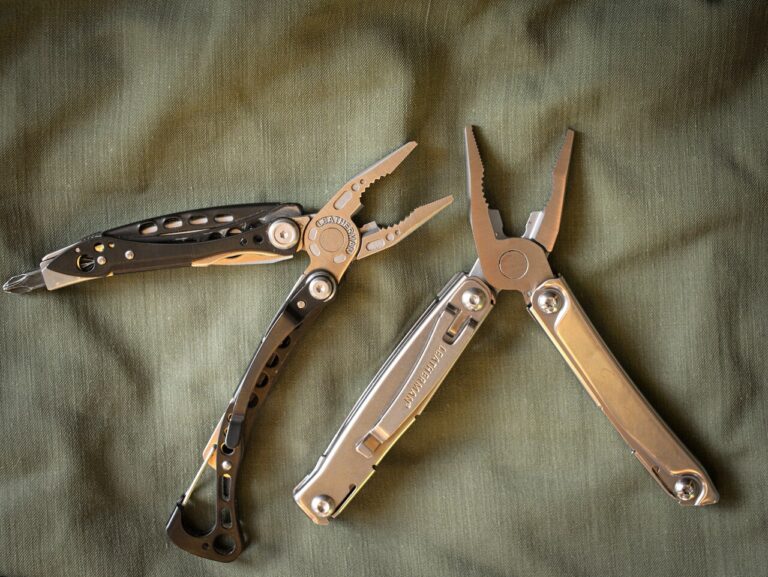
This is the sweet spot. The Leatherman Skeletool and Skeletool CX sit at the top here — 5 ounces is borderline but the slim profile and external blade access let it carry better than its weight suggests. The Victorinox Swiss Army Climber, Compact, and Tinker variants come in around 2.5 to 3 ounces and remain the gold standard for slim, organized tool layouts. The Leatherman Free T4 (no pliers, just a tool-only folder) at 3.4 ounces is a serious option for people who don’t actually need pliers.
This tier is where you have to start making real choices. Do you want pliers, or do you want scissors and a corkscrew? Do you want a one-hand-opening blade you can deploy without unfolding the tool, or are you fine with a nested blade you have to fish out? The Skeletool gives you pliers, a wire cutter, an outside-access blade, and a bit driver — but no scissors, no awl, no file. The Swiss Army gives you scissors, screwdrivers, a corkscrew, and tweezers — but no pliers and no one-hand blade. Pick the side of that line that matches your actual life.
Shop Leatherman Skeletool CX on Amazon
Tier Three: Compact-Ish Full Tools (4 to 6 oz)
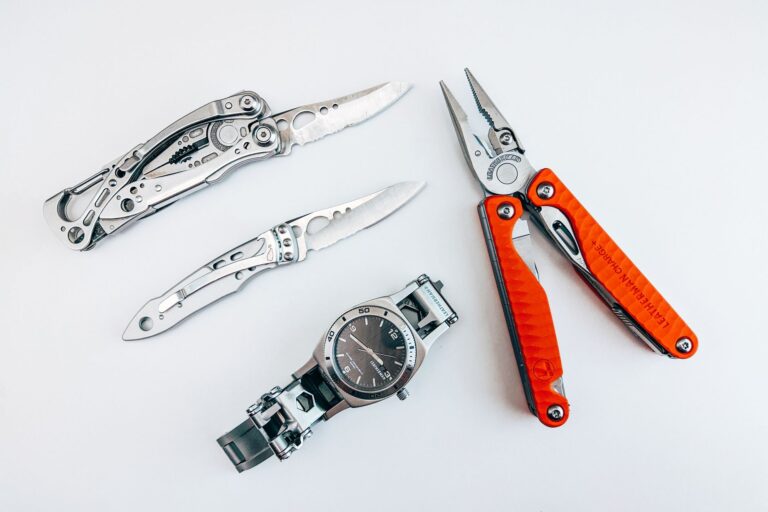
The Leatherman Wave+, Charge+, and Free P4 live here. Brand marketing calls them “compact.” Anyone who’s carried a true micro will tell you these are belt tools that got brave. They’re excellent at what they do — full-size plier jaws, real cutting blades, locking implements, bit drivers that don’t strip — but they will remind you they exist every time you sit down. If your daily life involves real work where the pliers and saw and file actually get used, this is the tier to live in. If your daily life is office, errands, and the occasional package, this tier is overkill that will end up in a drawer.
Which Tools Actually Earn Their Pocket Real Estate
Multitool makers brag about tool count. Twelve functions. Eighteen functions. Twenty-one. It’s mostly nonsense. The honest function inventory for a pocket multitool, ranked by how often it actually gets used in a non-tradesperson life, looks something like this:
- Blade — opens packages, trims threads, cuts cordage, slices fruit. Daily use.
- Scissors — hangnails, loose threads, opening blister packs. Weekly use for most people.
- Phillips and small flathead — eyeglass screws, battery compartments, tightening loose hardware. Monthly use.
- Pliers and wire cutter — stuck zippers, bent prongs, snipping picture wire, holding tiny nuts. Useful when needed but rarely the daily driver people assume.
- Tweezers — splinters, watch pins, SIM trays. Niche but irreplaceable when you need them.
- Bottle opener — depends entirely on your social life.
- File, awl, can opener, saw, ruler — almost never used by anyone who isn’t actively camping or working trades.
Notice that pliers are number four, not number one. Plier strength is what multitool ads sell, but for office workers, students, parents, and most desk-job EDC carriers, blade and scissors do far more work. This is why the Swiss Army format has survived for over a century — it ruthlessly optimizes for the tools normal humans actually use.
Build-Quality Markers That Separate Daily Drivers From Drawer Queens
Spec sheets won’t tell you which tools will still work in five years and which will develop wobble, rust, or sloppy detents after six months. A few honest tells:
Stainless Hardware All The Way Through
Cheap multitools save money on pivot pins and springs. Within a year of sweat and rain exposure, you get orange dots inside the handles and stiff joints. Leatherman, Victorinox, and SOG’s higher-end tools use stainless throughout. Bargain-bin gas-station multitools do not. The price gap looks unjustifiable until you’ve thrown two cheap tools in the trash.
Detents and Lock Mechanisms
Every implement should snap into place and stay there under load. A blade that folds back on your fingers because the detent gave out is dangerous, not just annoying. Leatherman’s Free series and the older Wave+ both feature individual locks per tool. Victorinox’s classic format relies on strong springs and a back-spring lock on larger blades. Avoid any compact tool where the implements rotate freely without resistance — that’s a design that will get worse, never better, with use.
Blade Steel
Most multitool blades use 420HC or similar mid-tier stainless. That’s fine — it’s tough, easy to sharpen, and corrosion-resistant. The Leatherman Skeletool CX upgrades to 154CM, which holds an edge noticeably longer. Premium steels like S30V are rare on multitools because the manufacturing cost doesn’t match the tool’s primary use case (which is breaking down boxes, not bushcraft). Don’t pay a huge premium for exotic steel on a tool whose blade is going to do utility work.
Matching the Tool to the Carry Context
The cleanest decision framework isn’t “which is best” — it’s “what does my daily routine actually demand.” A few honest matchups:
Office worker, mostly desk-bound: Victorinox Climber or Compact. Scissors, small blade, screwdrivers, tweezers. Slim, light, non-threatening profile if HR happens to notice.
Field worker, contractor, or hands-on hobbyist: Leatherman Skeletool CX or step up to the Wave+. Real pliers and a real blade that opens one-handed when your other hand is holding something.
Minimalist EDC, key-carrier: Leatherman Style PS or Gerber Dime Mini on the keychain. Always with you, handles the small stuff, never asks for pocket space.
Traveler who deals with airports: TSA-friendly tool-only options like the Leatherman Style (without blade) or a Victorinox Swiss Card. You can fly with them in carry-on.
Where Compact Multitools Quietly Fail
A few honest failure modes worth naming so you don’t get surprised. Bit drivers on compact tools use proprietary flat bits, not standard 1/4-inch hex. If you lose them, replacements are a hunt. Pliers on sub-3-ounce tools can’t grip a rounded-off bolt — the jaws flex before they bite. Scissors on cheap compacts use single-pivot designs that go dull within a year and can’t be resharpened. And every multitool blade is harder to sharpen than a dedicated knife because of the limited bevel access.
None of these are dealbreakers. They’re just honest limits of the form factor. A compact multitool is a Swiss-army solution to small problems — not a replacement for a dedicated pocket knife, a real screwdriver, or the toolbox in your garage. Stop expecting it to be one, and the value clicks into place.
The Honest Final Take
For most people reading this, the best compact multitool that fits in your pocket is either a Victorinox Swiss Army in the Climber or Compact layout, or a Leatherman Skeletool CX if you genuinely need pliers and one-hand blade access. The Squirt-class micros are excellent secondary keychain tools but won’t replace a real pocket tool for the medium-difficulty problems. Anything bigger than the Skeletool starts becoming a belt tool wearing a pocket-friendly costume, and you’ll feel that compromise every time you sit in a car or at a desk.
Buy once at the right tier for your life, learn its strengths, and stop scrolling new releases. A good compact multitool should be a ten-year purchase, not a quarterly upgrade. That’s the part the marketing never tells you, because nobody makes money selling tools that last.
Sources
References and further reading:
- Leatherman official product specs and tool dimensions
- Victorinox Swiss Army Knife reference catalog
- Gerber Gear multitool lineup and specifications
- Multi-tool history and design overview (Wikipedia)
Explore our top EDC gear picks at the EverydayCarryGuy shop →
Shop on Amazon
Multitools on Amazon →
As an Amazon Associate we earn from qualifying purchases.
Shop on eBay
Multitools on eBay →
We may earn a commission when you shop through our eBay links.
Survival & preparedness gear
Shop Survival Frog →
We may earn a commission when you shop through our Survival Frog link.