
Blade-Free and Boarding: The Real Utility Case for TSA-Safe Multitools
The first time you leave a multitool at a TSA checkpoint, the lesson sticks permanently. Blades — any blade, any length — are prohibited in carry-on baggage under TSA rules. That one hard constraint rewires how you think about what goes in your bag when you fly. Most EDC guys resist the blade-free setup because it feels like a downgrade. Spend enough time in airports with the right tool and that resistance starts to fade.
What follows is a deep read on the multitools worth carrying through security — not a summary of the rules, but a look at specific tools, construction quality, and real-world utility you get from committing to the blade-free approach.
Why TSA’s Blade Ban Is a Design Spec, Not Just a Rule
The TSA’s prohibited items list bans knives, box cutters, and all blades from carry-on bags. Not under a threshold, not with a waiver, not if folded. Any blade goes in checked luggage — or stays home. The 2.36-inch blade exemption that circulates online applies to European and international security frameworks, not TSA guidelines. Anyone running that rationalization through a U.S. checkpoint is guessing wrong.
What this means for gear selection is clarifying. You’re not trying to find the largest blade that slides through. You’re building a carry-on multitool from a completely different starting point: which non-blade tools matter for travel, and which products execute them best. The manufacturers who took that question seriously built genuinely useful tools. The ones who retrofitted a blade-free version of an existing platform often didn’t.
Leatherman and Victorinox both built purpose-designed travel multitools — not stripped-down versions of existing lineups, but tools where blade absence was an engineering decision from the beginning. That distinction shows up in the tool layout, the size, and which capabilities each brand prioritized.
What You Actually Lose Going Blade-Free
The honest answer is: less than you’d expect, for the specific context of air travel.
Think through what a multitool actually gets used for between check-in and hotel check-out. Tightening the screw on a luggage handle that’s worked itself loose. Cutting the plastic zip-tie off a checked bag after customs inspection. Snipping the thread that started unraveling from a carry-on strap. Opening a package at the hotel. Driving the battery cover screw back into a TV remote. These tasks call for scissors, pliers, and screwdrivers. Not once in that list does a cutting blade show up as the right tool.
Where a blade does matter: breaking down cardboard, cutting rope or webbing, food prep, field work. These are trip-specific scenarios, not everyday transit needs. If your work regularly requires a blade in the field, the correct answer is a blade multitool in checked luggage and a blade-free carry-on tool — not trying to compress both use cases into one compromised piece.
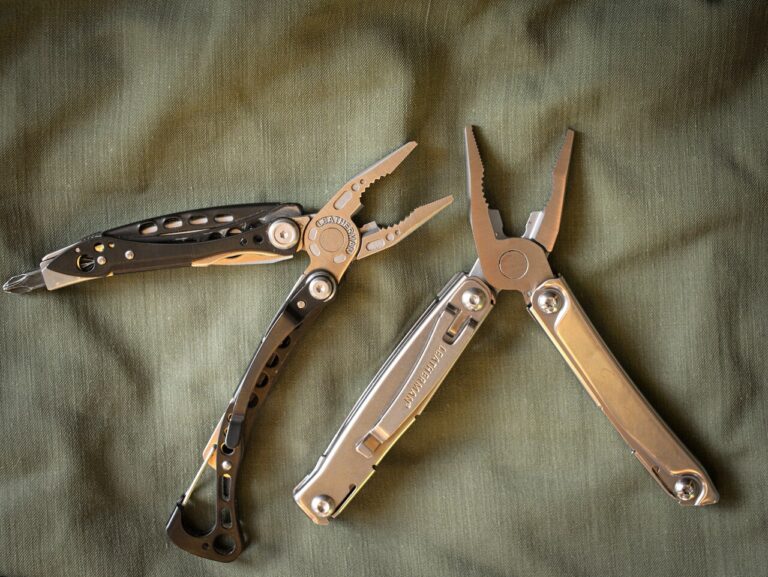
Leatherman Style PS — The Reference Standard for Carry-On Multitools
The Leatherman Style PS is the most widely recommended blade-free travel multitool on the market, and the reasoning is straightforward: it was built for this purpose from the beginning. Leatherman markets it explicitly as TSA-compatible, and the tool set reflects an honest read of what travelers actually reach for.
The Style PS runs at 2.8 inches closed, 2.1 ounces. On the tool side: spring-action needle-nose pliers with a wire cutter, spring-action scissors, small Phillips screwdriver, medium flathead screwdriver, a file, a bottle opener, and a carabiner clip. Build material is 420HC stainless steel throughout.
The spring-action pliers are the headline feature. They open automatically when you release grip, which matters more than it sounds when you’re working in a confined space — inside a bag pocket, behind a panel, on a seat recline mechanism. The grip and leverage are real, not nominal. These are tools you’ll actually use on a luggage zipper pull that’s bent off-axis, not just carry for peace of mind.
The scissors run spring-action as well, with a 4.8cm cutting edge — just under the UK Civil Aviation Authority’s 6cm limit, which matters if you’re flying through Heathrow or Manchester and want a single tool that clears both TSA and UK checkpoints without adjustment. They handle tape, thread, and packaging without binding. The Phillips driver covers the most common hotel and electronics screws in a format small enough to use inside a bag. The file works as both a nail file and light deburring tool if you’re dealing with sharp edges from damaged luggage hardware or frayed cable ends.
The carabiner isn’t decoration. Clip it to a bag strap loop and the tool disappears until you need it — the ideal carry configuration for a travel multitool. You stop thinking about where it is. It’s always there.
Retail runs $30–40, frequently on sale below $30 on Amazon.
Shop Leatherman Style PS on Amazon
Leatherman Squirt PS4 — The Keychain Format Argument
If the Style PS is the bag-clip option, the Leatherman Squirt PS4 makes the case for keychain deployment. Closed length: 2.25 inches. Weight: 2.3 ounces. It lives on your key ring, which means it’s on your person whether you packed it intentionally or not. For a travel tool, that’s a meaningful operational advantage — it doesn’t require a packing decision to be present.
The Squirt PS4 is blade-free. Its tool list: spring-action needle-nose pliers with wire cutter, small Phillips driver, small flathead, extra-small flathead, scissors, file, bottle opener, and a wire stripper. The wire stripper is the detail that sets it apart from the Style PS and shows up more than expected for anyone managing adapters, cables with fraying sheathing, or in-room tech repairs on a work trip.
The needle-nose pliers are the standout at this scale. Spring-action pliers that close with real grip under torque are rare at 2.25 inches closed. Most keychain pliers are decorative. The PS4’s pliers function under load — the difference between actually fixing a bent luggage frame and wishing you had a real tool.
Trade-offs are real. The scissors are smaller than the Style PS and require noticeably more effort on anything beyond thread or thin packaging. The drivers generate minimal torque, limiting them to eyeglass screws and small electronics. These are the constraints of keychain form factor. If you need leverage, the Style PS is the correct choice. If you need the tool to live on your keychain with zero additional thought, the PS4 wins that decision.
Price: $30–35 retail, frequently available below that.
Shop Leatherman Squirt PS4 on Amazon
Victorinox Jetsetter Plus — When Scissors Are the Whole Point
The Victorinox Jetsetter Plus is the Swiss option, and it’s blade-free by design — not a stripped-down Classic SD, but a product built specifically for air travel from the start. Its tool set: scissors, nail file with screwdriver tip, flat screwdriver, bottle opener, wire stripper, and an LED light.
The scissors are the reason to choose this over either Leatherman. Victorinox’s small-format scissors carry a reputation built over decades — they cut cleanly on the first pass, stay sharp longer than competitors, and operate with noticeably less effort than comparable keychain scissors. For a traveler whose primary use case is cutting (packaging, tags, thread, clothing repairs, hanging labels), the Jetsetter’s scissors win the comparison outright. It’s the one tool in this category where the Swiss Army brand name actually means something measurable in the hand.
What the Jetsetter lacks: pliers. Swiss Army architecture is built around slotted tools in a frame, not the pivot-point plier design Leatherman uses. If luggage hardware, cable management, or anything requiring grip and torque is your main travel concern, the Jetsetter doesn’t solve it. This is a scissors-and-drivers tool first, a minimalist package second, and a no-pliers trade-off you need to make deliberately.
Retail: $20–30. At 1.1 ounces, it’s the lightest option in this comparison. Cheaper than either Leatherman, with no meaningful loss in tool quality for the tasks it’s actually designed to handle.
Shop Victorinox Jetsetter Plus on Amazon
Security Outside the U.S. Doesn’t Run on TSA Rules
TSA guidelines are U.S.-specific. International airports operate under their own frameworks, and those frameworks vary enough to matter on a real routing. The UK Civil Aviation Authority prohibits scissors with blades longer than 6cm in the cutting edge — the Leatherman Style PS scissors come in at 4.8cm and pass cleanly, but there’s no universal guarantee that any blade-free multitool clears every jurisdiction identically. At the checkpoint level, officer discretion applies everywhere.
EU airports follow ECAC standards broadly similar to TSA restrictions but interpret tool classification differently depending on the airport and the screening officer. Japan and Singapore run methodical, thorough screenings where anything resembling an implement goes under close review. Australian TravelSecure guidelines take a broadly similar approach to TSA, but the interpretation gap between policy and checkpoint can be real. The most consistent principle across all of these jurisdictions: a compact, folded, carabiner-clipped tool that reads visually as a pocket toolkit passes faster than anything that requires an explanation or a judgment call to get through.
If you’re flying international routes regularly, look up the specific security guidelines for your destination country before travel — not to find loopholes, but to avoid the secondary screen that eats 20 minutes. All three tools covered here clear TSA. For international routing, verify before you fly.
How This Plays Out When You’re Actually Moving
The setup most frequent travelers land on after enough checkpoints: a blade-free carry-on tool as the daily-carry piece that never requires a packing decision, alongside a full-size multitool with a real blade in checked luggage for trips where extended field use or outdoor work is on the agenda. A Leatherman Wingman or Wave Plus goes in the checked bag. The Style PS or Squirt PS4 goes on the keychain or bag strap and stays there through security without a second thought.
For pure carry-on trips — a week or under, business travel, international runs where you’re moving fast and light — the blade-free setup is the complete answer. A Style PS handles the overwhelming majority of what goes wrong in transit. For the occasional task a blade would handle faster, you improvise or pick up a cheap utility knife near your destination and leave it when you check out. That’s not a compromise. It’s a rational system built around how air travel actually works.
The adjustment that takes time is mental, not functional. EDC culture conditions you to want the full toolkit everywhere, all the time. Travel teaches you to build systems within real constraints. A blade-free multitool engineered specifically for air travel is one of the cleaner solutions to that problem — the tool you stop noticing you’re carrying until you need it.
Sources
- TSA — Transportation Security Administration
- Leatherman Tools — Official Site
- Victorinox — Official Site
- UK Civil Aviation Authority