Pocket Multitool Reality Check: What You Gain and Lose Going Compact
The best compact multitool isn’t the smallest one you can find — it’s the smallest one that still does what you actually need. That distinction matters because the market is full of keychain tools disguised as multitools, stripped-down versions of full-size models that kept the name but lost the function, and genuinely capable tools that simply got the proportions right. Sorting between them means understanding exactly where the tradeoffs live when you shrink a multitool down to true pocket scale.
The Size Line That Changes Everything
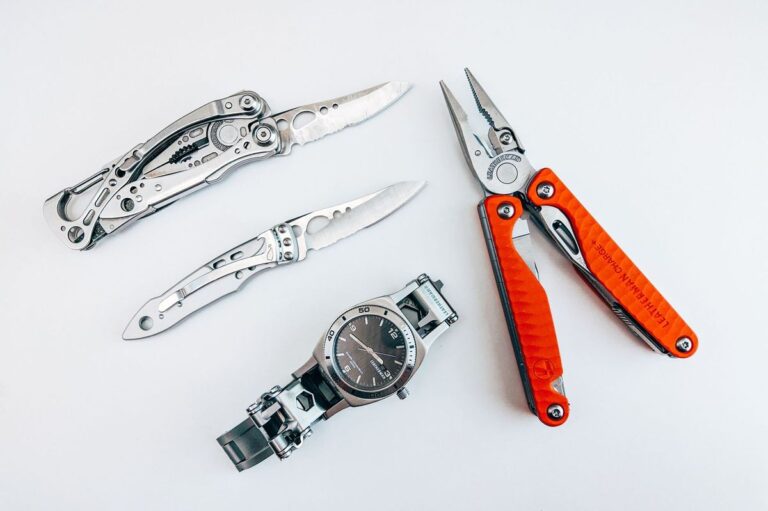
Full-size multitools run roughly 4 to 4.5 inches closed. The Leatherman Wave+ sits at 4 inches, the Charge TTi at 4.5, the Gerber Center-Drive at 4.6. They’re full-featured, heavy at 7 to 12 ounces, and don’t fit comfortably in a jeans pocket when you’re already carrying keys, a wallet, and a phone. They belong on a belt clip or in a bag — which means they don’t come out for the casual grab-and-fix moment because the moment of use rarely justifies going to your bag.
Compact multitools break under 3.5 inches closed and under 4 ounces. The real pocket-carry sweet spot is tighter: under 3 inches closed, under 3 ounces, no clip required — drop it in a pocket and it stays flat. The Leatherman Squirt PS4 (2.6 oz, 2.6 inches closed), the Gerber Dime (1.9 oz, 2.75 inches), and the Leatherman Free T4 (3.3 oz, 3.3 inches) all occupy this zone, each representing a different philosophy about where to place the compromises.
The physics are unforgiving in one direction. Shorter handle halves mean a reduced plier jaw span. The Squirt PS4’s jaw opens to roughly three-quarters of an inch — about 60 percent of what the Wave+ can grip. For most daily repairs — eyeglass screws, staple removal, small bolt work, terminal connectors — that’s adequate. For mechanical work where real grip force is required, you’ll notice the difference immediately. Knowing this before you buy determines whether you’re disappointed or pleasantly surprised after the first month of carry.
Pliers or Not — The Category Split That Defines Your Use Case
The most important question in compact multitool selection isn’t brand or price — it’s whether you need pliers at all. Two distinct sub-categories exist here, and they serve genuinely different users who often talk past each other in gear forums and purchase reviews.
Pliers-based compacts — the Squirt PS4, Gerber Dime, Free T4, Victorinox Spirit X — fold out into needle-nose pliers as the primary tool, with blades, files, and screwdrivers folding into the handle halves. This is traditional multitool architecture compressed into a pocketable form factor. If your daily carry includes any kind of hardware, cable, terminal, or fastener manipulation, the pliers matter and this is your category. The pliers-first design also gives the tool structural rigidity when closed — handles that form the plier body are more solid at compact scale than blade-only handle stacks.
Blade-and-scissors compacts — the Victorinox Cadet, Leatherman Style PS — are architecturally closer to an evolved Swiss Army knife. Built around a blade and scissors rather than pliers, they’re thinner, lighter, and better suited to users whose daily cuts involve packaging, cord, or tape. The Cadet at 0.74 oz is legitimately invisible in a pocket. But if your definition of a multitool includes fixing anything mechanical — even tightening a loose hinge screw — this category won’t satisfy. Most users asking about compact pocket multitools are thinking pliers-based, and should rule the blade-only designs out early in the decision process.
How Compact Tool Makers Solve the Space Problem
Full-size multitool handles are large enough to include tools on the exterior edges that deploy without opening the pliers — the Wave+ approach, where you can pull out the blade or file one-handed while the tool stays closed. Shrink the handles and you lose that exterior real estate. Most compact multitools require you to open the pliers first, then rotate individual inside-handle tools out by hand. That workflow difference is real for any user who frequently accesses a specific tool without needing the pliers at the same time.
Leatherman addressed this directly with the Free T4. Instead of exterior tool deployment, it uses magnetic catches that allow one-handed access to any tool — push a tool out and the magnet holds it at full extension without a locking detent. At 3.3 oz and 3.3 inches closed, the Free T4 is marginally larger than the Squirt PS4, but it carries 12 tools with a deployment experience meaningfully closer to a full-size multitool. That extra ounce and quarter inch buys a genuinely different interaction model.
Tool selection compression reveals the other engineering challenge at this scale. A Squirt PS4 includes nine tools: needle-nose pliers, regular pliers, wire cutters, hard-wire cutters, a 420HC blade, serrated blade, scissors, flathead screwdriver, and Phillips screwdriver. For a 2.6-ounce tool, that’s a complete working kit. The Gerber Dime reaches 12 tools at 1.9 oz by adding a bottle opener, tweezers, and a file, though the plier robustness takes a corresponding hit. The Free T4’s 12 tools include a One-Hand+ bit driver that makes it the most versatile in the class for precision fastener work. None of these choices is wrong — they reflect where each manufacturer drew the line on what the user actually needs versus what serves as marketing padding.
Wire cutters deserve specific attention at this size class. Leatherman hardened their cutter blades and made them replaceable on both the Squirt PS4 and Free T4 — an approach consistent with their full-size line and an underrated feature at compact scale. Gerber’s Dime cutters handle light-gauge wire adequately but wear faster under regular use. If your carry involves any electrical or automotive maintenance, that difference accumulates quickly over months of use.
Shop Leatherman Squirt PS4 on Amazon
What Consistent Pocket Carry Actually Reveals
Spec sheets are the starting point. Real carry for a few weeks is where a compact multitool proves itself or doesn’t. A few patterns emerge consistently after putting these tools through actual daily use rather than benchmarks.
Clip or no clip: most compact multitools ride loose at the pocket bottom. At under 3 oz, they’re light enough that this isn’t annoying — they’re not the thing dragging your pocket down. The Free T4 includes a removable pocket clip for users who want the tool at a fixed spot rather than floating. The Squirt PS4 and Dime are clip-free and generally forgotten until needed, which is either the ideal carry outcome or a frustrating one depending on how deliberate you are about pocket organization.
Handle texture and grip surface matter more at compact scale than at full size. When the tool is 2.6 inches closed, your available grip surface is inherently limited, and any task requiring torque — driving a screw, bending wire — amplifies the consequence of a slick handle. The Squirt PS4’s textured stainless handles provide enough purchase to apply real torque without the tool rotating in your palm. The Dime’s smoother handles demand more grip discipline on the same tasks. After a week of real use, this distinction shows up in small but frequent ways that don’t appear in any product listing.
Blade deployment in inside-handle tools means running your thumbnail into a nail nick, and at compact scale those nicks are smaller than on full-size multitools. In normal carry conditions this is a non-issue. With gloves, cold hands, or wet fingers, it becomes a real access problem. The Free T4’s magnetic deployment sidesteps this entirely for every tool in the kit. The Squirt PS4 and Dime require deliberate nail-nick access that rewards patience and penalizes urgency. Know which scenario your daily carry will actually present before choosing.
The Steel and Build Grade Picture
Compact multitools don’t always carry the same steel spec as their full-size siblings, and it’s worth verifying before assuming. The Leatherman Squirt PS4 and Free T4 both run 420HC on the blade — the same grade Leatherman uses throughout their main line, which is a meaningful consistency signal. 420HC is a practical choice for an EDC cutting tool that sees light daily use and needs to be sharpenable in the field without specialized equipment. It’s not a premium steel by any current standard, but it’s honest about what this tool format is designed to do.
Gerber’s Dime uses 2Cr13 — a softer, lower-carbon stainless that dulls faster under regular cutting load. For occasional-use carry in a bag or vehicle, that’s an acceptable tradeoff at the price point. For daily carry where the blade handles multiple cutting tasks every day, the edge retention difference between 2Cr13 and 420HC shows up within a few weeks. The Dime is a genuinely capable tool for its price; just be honest about your use frequency before assuming the blade will perform the way a Leatherman does.
Shop Leatherman Free T4 on Amazon
Manufacturing tolerance shows up in ways no spec sheet captures. Leatherman’s pivot tolerances are consistently tighter than Gerber’s at comparable price points — less tool wobble when open, smoother plier action through the full range, pivots that don’t loosen noticeably after months of daily use. Open and close the pliers on a Squirt PS4 and a Dime side by side, fifty times each. The build quality difference is immediate and correlates directly with long-term reliability in pocket carry.
TSA-Friendly Carry and the Blade-Free Option
Flying carry-on only changes the math entirely. TSA classifies any multitool with a blade as a prohibited item regardless of blade length — the category itself triggers confiscation, not the specific dimension. Any of the pliers-based compacts above with a blade goes in checked luggage or gets left at the security bin. This is a consistent point of frustration for travelers who assumed a small blade on a compact tool would be treated differently than a folder.
The Leatherman Style PS solves this directly. At 1.4 oz, it includes spring-action scissors, tweezers, a small flat screwdriver, a carabiner clip, and a bottle opener — no blade, no cutting tool that triggers TSA screening. It’s the one tool in this category explicitly engineered and marketed for carry-on use. What it doesn’t do is replace a pliers-based multitool for repair work of any kind. The Style PS is a travel complement, not a daily carry substitute — buy both if you fly regularly with carry-on only rather than trying to make one tool cover both scenarios.
Shop Leatherman Style PS on Amazon
Making the Pick
The compact multitool decision narrows to three variables: how often you use pliers specifically, whether you travel carry-on only, and how much tool-deployment friction you’ll tolerate daily. Most pocket carry users land on the Squirt PS4 as the honest baseline — light enough to forget about until needed, functional enough to actually reach for when something requires a tool, built to a standard that holds up over years without becoming a maintenance project. The Free T4 earns its premium for users who deploy individual tools frequently enough that magnetic one-hand opening shifts from a marketing feature to a real daily improvement. The Dime serves bag carry, vehicle kits, and equipping a second location well — it’s a capable tool at its price, not the pick when daily carry performance is the primary metric.
The compact multitools that earn long-term pocket time share one quality no spec sheet captures: they disappear into the carry until they’re needed, then deliver without drama. Size and weight get them into the pocket in the first place. Build quality and tool selection keep them there. The ones that end up left on a desk after two weeks failed on the second requirement, not the first.
Sources
- Leatherman — Official product specifications and tool documentation
- Gerber Gear — Dime multitool specifications and materials
- TSA — What Can I Bring: knives, multitools, and sharp objects
- Victorinox — Swiss Army tool lineup and product specifications