Best Compact Multitools That Fit in Your Pocket: What the Spec Sheet Won’t Tell You
The “compact multitool” wall at any gear retailer will sell you on tool count before you can get the packaging open. Twelve tools at 2.2 ounces sounds like a win until you’ve tried to torque a stubborn panel screw with pliers that flex sideways under load, or sliced through corrugated cardboard with a blade that rolls on the second pass. The best compact multitools that fit in your pocket aren’t the ones with the most features listed on the blister card — they’re the ones built around the two or three jobs you’ll actually ask them to do, with the construction quality to do those jobs without turning into a frustration exercise. Here’s how to read a compact multitool for what it actually is before you commit pocket space to it.
The Size Floor That Actually Means Something
The compact multitool category has no official boundary, but for true front-pocket carry that doesn’t print through everyday chinos or create a lump that shifts every time you walk, two numbers matter: closed length under four inches and weight under three ounces. Drop below 2.5 inches closed and you’ve crossed into keychain tool territory — useful, but optimized for a narrower set of tasks. The pliers get too short to generate real mechanical advantage, the driver geometry shrinks past the point of reliability, and the knife blade becomes barely functional for anything beyond opening a padded envelope.
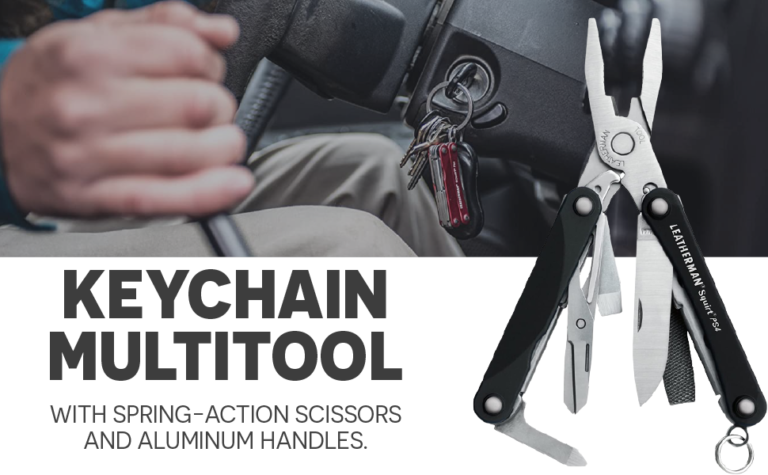
The sweet spot for a front-pocket daily driver sits between 2.75 and 3.5 inches closed. Small enough to disappear in the watch pocket of standard-cut jeans, substantial enough that the tools have real bite to them. On the weight side, anything north of three ounces starts to register as a penalty every time you put your pants on. You notice it, and eventually you start leaving the tool on the dresser. The Leatherman Squirt PS4 hits 2.3 ounces at 2.25 inches closed. The Gerber Dime runs 2.2 ounces at three inches closed. Both pass the daily carry test comfortably. Push north of three ounces and you’re entering mid-size territory — still clippable with jeans, but no longer a true compact pocket carry.
Pliers First or Blade First: What the Design Tells You
Every compact multitool has a primary design philosophy baked into how it opens. On pliers-first designs — the Leatherman Squirt PS4 and Gerber Dime are the two most common examples at this size — the needle-nose pliers are the opening move. The handle scales swing out, you grip them, and every other tool (knife blade, file, screwdrivers) lives nested in the handles, accessible from the exterior face. The pliers are literally the structural core of the tool. That tells you immediately what the designer thought you’d reach for first: wire work, hardware pulls, grip tasks, anything that requires mechanical advantage over a small area.
Blade-first compacts lead with the knife and treat any pliers as a secondary feature, which is almost always reflected in the quality. You’ll find them in modified Swiss Army configurations and ultra-compact keychain tools where cutting utility is the hero. For the person who opens packages, cuts fishing line, and does light trim work, that hierarchy makes complete sense. For anyone who strips stranded wire, bends cotter pins, or needs real grip on a fastener that won’t move by hand, blade-first compacts will disappoint on the pliers every single time. The jaw faces are too short for real torque, the spring is too soft, and the mechanical advantage simply isn’t there at this scale. Knowing which design camp you’re shopping from narrows the field dramatically before you ever handle a tool.
Spring Tension Is the Spec Nobody Advertises
The practical gap between a quality compact multitool and a frustrating one often comes down to one unsexy, unadvertised spec: return spring tension on the pliers. On any dual-action pliers design where both jaws move toward center, the return spring is what snaps the handles back open between squeezes. Weak springs make the tool feel mushy — you squeeze, release, and have to manually pry the handles apart for the next bite. In practice, you end up working with two hands when the tool was supposed to let you work with one. Strong springs make the tool feel purposeful. Squeeze, release, it pops back ready for the next cycle.
Leatherman has owned this spec since the original PST, and the Squirt carries it forward. The spring tension on the Squirt PS4 is noticeably tighter than most competitors in its price bracket. Work it through a hundred squeeze cycles and it snaps back every time without losing response. The Gerber Dime uses a lighter spring that makes one-handed operation easier if hand fatigue or grip strength is a factor, but feels less authoritative when you’re applying real torque to a bolt that doesn’t want to move. Neither calibration is wrong — they’re tuned for different users. The problem is that spring tension is invisible from any product page or marketing copy. You need to handle the tool in person or read reviews written specifically about pliers feel rather than tool count.
Three Compact Multitools That Prove the Category Right
Leatherman Squirt PS4
At 2.25 inches closed and 2.3 ounces, the Squirt PS4 is the benchmark compact pliers multitool against which everything else in this size class gets measured. Nine tools: needle-nose pliers, regular pliers, wire cutter, a 420HC blade, file with screwdriver tip, Phillips driver, and spring-action scissors. The 420HC blade steel isn’t premium, but Leatherman’s heat treatment on it is legitimate — it takes an edge well, holds up through normal daily cutting without rolling, and stropping it back to working sharpness takes less than a minute. The pliers carry the characteristic Leatherman snap, and the wire cutters handle stranded 14-gauge electrical cleanly without the jaw faces flexing laterally under load. Lateral jaw drift is the failure signature of cheap compact pliers; the Squirt doesn’t do it.
The Squirt’s one friction point is the tool access logic. Because every implement nests in the handle scales, getting to the Phillips driver or file requires flipping the tool to the exterior face of the handle — swing the right scale and the driver is there. First-time users find this disorienting for about a week, then it becomes automatic muscle memory. The Squirt doesn’t ship with a pocket clip; Leatherman sells one separately that mounts to the keychain bail. Buy it at the same time. Without it, the Squirt is a loose-pocket or keychain carry, and the clip transforms it into something you can actually index in a jeans pocket without fishing.
Shop Leatherman Squirt PS4 on Amazon
Gerber Dime
The Gerber Dime costs significantly less than the Squirt and carries 12 tools in a three-inch, 2.2-ounce package — including a bottle opener and a dedicated package opener that the Squirt doesn’t carry. For a carry where lifestyle utility matters as much as mechanical work, the Dime pulls its weight. The blade steel is Gerber’s unlisted proprietary spec, which is honest shorthand for budget stainless: functional for light daily cutting, but due for resharpening more frequently than the Squirt. The pliers are adequately sprung rather than snappy, and the overall construction is solid without feeling machined to tight tolerances.
Where the Dime genuinely stands out is ergonomics at the compact scale. The handle scales carry a mild texture that gives you noticeably more grip control than the smooth stainless scales on most competitors. The integrated carabiner clip on the tail is one of its most-used features in practice — useful for clipping directly to a bag zipper pull or belt loop for quick access, without needing a separate clip accessory. The clip doubles as a money clip in a pinch. If you’re budget-aware and your primary use cases run toward opening packages, turning small screws, and having a bottle opener handy, the Dime is a legitimate daily driver. A lot of serious EDC carriers run one as a bag-attached backup to a full-size multitool for exactly this reason.
Victorinox Cadet Alox
If pliers aren’t a regular need and what you want is the most refined cutting and light utility in the smallest possible package, Victorinox takes the category at this scale. The Classic SD — 2.25 inches closed, 0.74 ounces — delivers a small blade, spring-action scissors, nail file, screwdriver tip, tweezers, and toothpick in a package that weighs nothing and disappears wherever you put it. The scissors on the Classic SD are the standout feature: legitimately sharp, smooth-actioned, and better than anything at a comparable size or price from any other manufacturer. For a commuter or office carry, the scissors alone justify the purchase.
Step up to the Cadet Alox and the frame grows to 3.25 inches with aluminum handle scales in Victorinox’s distinctive Alox texture. The tool loadout shifts: larger main blade, nail file, can opener, and two flathead screwdriver sizes. No scissors, no pliers — but the build quality is a clear step above the plastic-handled Swiss Army range. The Alox scales are grippy without being sharp against the palm, the blade is Victorinox’s stainless formulation that holds a working edge meaningfully longer than budget multitool steel, and the pivot tension is tight enough that tools don’t flop when you want them locked out. For EDC carried alongside a dedicated folder, either Victorinox option functions as a precision utility kit rather than a general-purpose multitool.
Shop Victorinox Cadet Alox on Amazon
Pocket Real Estate and Carry Geometry
How a compact multitool carries day-to-day is a completely separate conversation from how it performs on a task, and most buyers don’t think it through until they’ve already bought. True compacts under 2.5 inches closed generally don’t ship with an integrated pocket clip. They’re designed for keychain carry or loose pocket carry, which means the tool lives at the bottom of your pocket until you dig for it, or rides your key ring and adds unbalanced weight every time you pull your keys out. For a tool you use occasionally, that’s an acceptable tradeoff. For a daily-use tool, you start wanting it in a dedicated indexed position.
For front-pocket carry without a clip, the Squirt and the Dime both sit flat enough that pocket presence is nearly zero in jeans or chinos — you won’t know they’re there until you reach for them. The watch pocket of standard jeans is the ideal home for either: it keeps the multitool separated from keys and phone, and you always know exactly where to reach. Keychain carry works but creates an asymmetrical lump and makes key extraction bulkier than it needs to be. If clip carry is a priority and you want the tool indexed like a knife, you’re looking at stepping up to the 3.5-to-4-inch compact range where tools like the Leatherman Juice series live — a different weight class and footprint, but significantly more accessible in a clipped configuration.
The Three Tasks That Expose a Cheap Compact Multitool
Before committing to any compact multitool, run it through three specific tasks and the picture becomes clear in under five minutes. First, strip 14-gauge stranded wire with the pliers. The jaw faces should bite the insulation and pull cleanly without the jaws flexing laterally or the handles torquing in your grip. Lateral flex under load is the giveaway on cheap pliers — the jaw geometry is off, or the steel is too soft, and you’re fighting the tool rather than using it. A pliers that drifts sideways under that load will never feel right, no matter how many times you use it.
Second, drive an M4 Phillips screw through ten full turns. The driver bit should seat fully in the recess and drive without camming out. A bit that strips immediately reveals incorrect geometry — usually a recess angle that’s too shallow for the Phillips spec. Third, cut a zip tie with the main blade. This tests both out-of-box edge quality and pivot tension simultaneously. A blade that drags through the pivot or has to saw rather than slice tells you the edge angle is wrong or the blade came from the factory unfinished. Quality compact multitools clear all three tests without comment. Budget options typically pass the zip tie and fail the wire stripping or screw driving under any real applied load. Knowing the failure point tells you exactly what class of tool you’re actually buying and what use cases it can realistically handle.