The Sub-$50 Knife That Lasts: A Maintenance Guide for Making Cheap EDC Steel Punch Above Its Price
Here’s the thing nobody selling you the best budget EDC knives under $50 wants to admit: the steel is almost never what kills a cheap knife. What kills it is a gritty pivot nobody ever flushed, a rust freckle nobody wiped off after a sweaty summer carry, and an edge that got “touched up” on the bottom of a coffee mug until the geometry was gone. A $35 CIVIVI or a $30 Ontario Rat isn’t a disposable knife. Treated right, it will out-cut a $250 flipper that lives in a drawer because its owner is too precious to actually use it.
This is not a roundup of which blade to buy. It’s the part that comes after — the boring, repeatable upkeep that turns a budget folder into a ten-year tool. If you already own a cheap knife you like, this is how you make it last. If you’re about to buy one, this is why you shouldn’t be scared of the price tag.
Why budget knives actually die (it’s rarely the blade)
Spend any time in EDC forums and you’ll see the same three failure stories on repeat, and none of them are “the steel was too soft.” The first is corrosion. Budget stainless like 8Cr13MoV and AUS-8 is genuinely stain-resistant, not stain-proof, and a knife that lives in a pocket next to a warm, damp thigh in a Taipei summer will pit if you never dry it. The second is pivot contamination — pocket lint, denim fuzz, and dust pack into the pivot and washers until the action goes from buttery to sandy, and people assume the knife is “worn out” when it just needs a flush. The third is bad sharpening: rounding the edge over on the wrong angle until you’ve reshaped the bevel into a butter knife, then blaming the metal.
Every one of those is user-side, not manufacturer-side. Which is great news, because it means the difference between a knife that lasts a year and one that lasts a decade is about fifteen minutes of attention a month.
Know your steel before you touch a stone
You can’t maintain what you don’t understand, and the sub-$50 shelf is dominated by four steels, each with its own personality on the stone.
8Cr13MoV — the honest workhorse
This is the steel in the Ontario Rat 1 and Rat 2, countless Kershaws, and a huge slice of the entry-level market. It takes an edge fast, loses it faster than premium steel, and — critically — is a joy to re-sharpen. Low carbide content means it’s forgiving on a stone; you can bring a dull Rat back to shaving-sharp in a couple of minutes on a medium ceramic. The trade-off is edge retention, which is exactly why the maintenance mindset matters here. This isn’t a knife you sharpen twice a year; it’s one you strop weekly and touch up monthly.
D2 — the semi-stainless value king
D2 is the reason the sub-$50 category got genuinely good. The CIVIVI Elementum built its reputation on it: real edge retention that embarrasses the price, a toothy edge that saws through cardboard and rope, and hardness in the 59–61 HRC range that used to cost three times as much. The catch is that D2 is only semi-stainless — around 12% chromium, below the ~13% threshold for true stainless — so it will develop patina and surface rust if you ignore it. It’s also more stubborn on the stone than 8Cr; the vanadium and chromium carbides that give it retention also mean you want at least a decent diamond or good ceramic to sharpen it efficiently. A worn-out $2 pull-through will just polish the burr and frustrate you.
14C28N and AUS-8 — the balanced middle
Sandvik 14C28N (Kershaw Leek, many Sencut models) is arguably the best all-rounder under $50: genuinely stainless, fine-grained, takes a screaming-sharp edge, and holds it respectably. AUS-8 sits nearby — a little softer, extremely easy to maintain, very corrosion-resistant. If you hate sharpening, these two steels are your friends, because they respond to a quick strop better than almost anything else in the price bracket.
The practical upshot: match your effort to your steel. A 14C28N Leek wants stropping and the occasional touch-up. A D2 Elementum wants a diamond plate and a patina you learn to love. An 8Cr Rat wants frequent, fast, low-stakes sharpening. None of them want neglect.
Shop the CIVIVI Elementum on Amazon
The sharpening routine that actually works
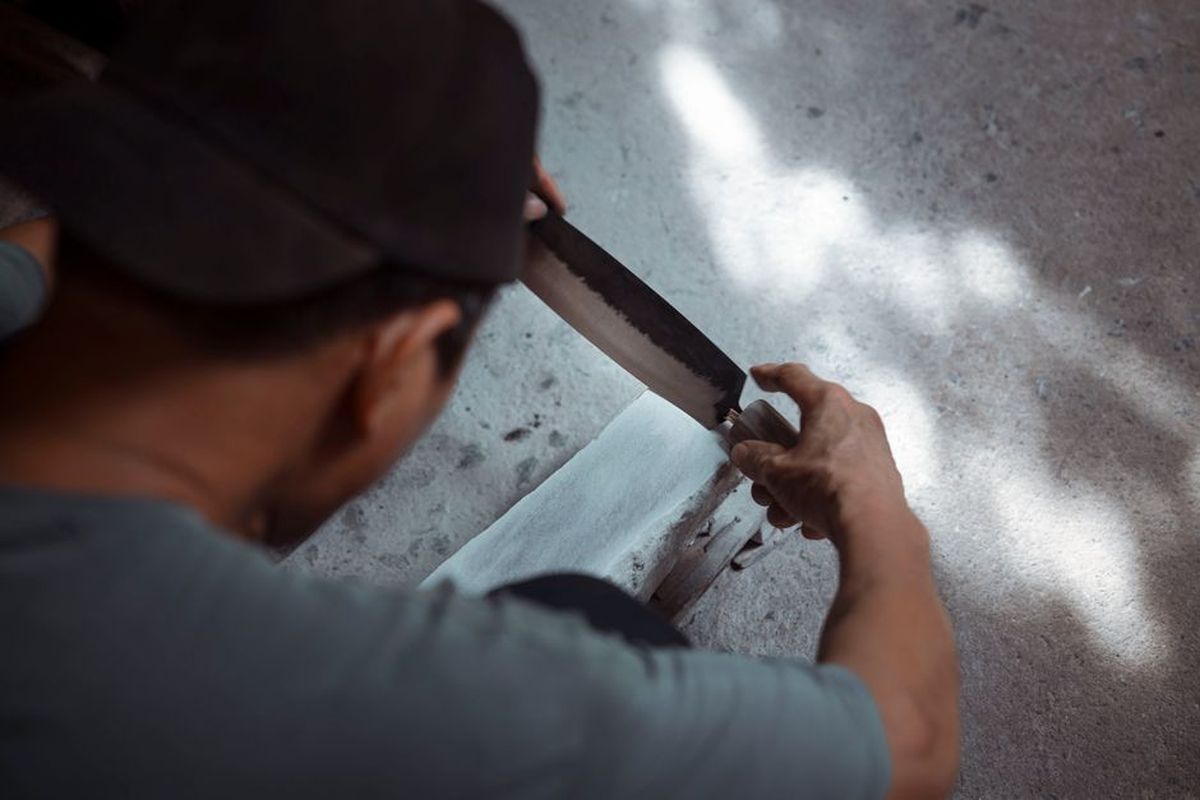
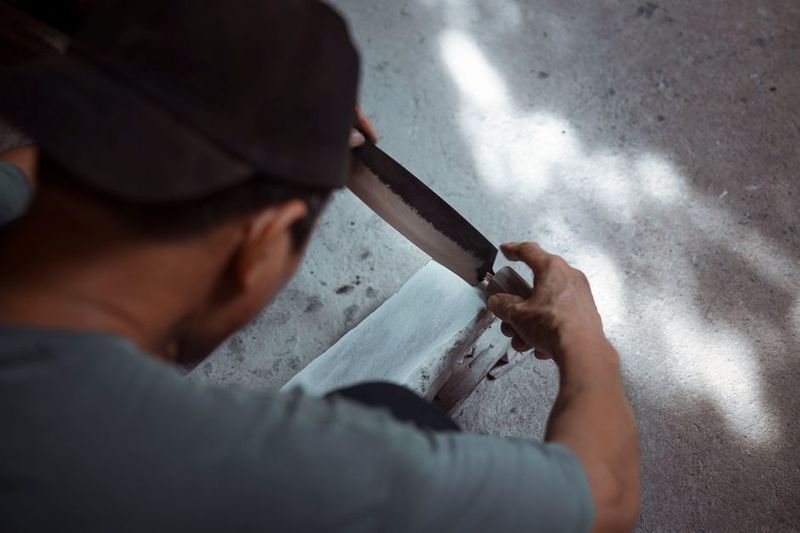
Forget everything the mall kiosk taught you. Sharpening a budget folder is about two things: consistent angle and finishing the burr. Nail those and cheap steel gets scary sharp.
Pick one angle and never guess
Most factory EDC edges live around 20 degrees per side. The single biggest upgrade you can make to a beginner’s sharpening is removing the guesswork. A guided system — the Lansky, the Worksharp Precision Adjust, or any fixed-angle jig — locks the bevel so every stroke hits the same spot. If you’re freehanding, a cheap angle cube or even a folded piece of paper to check your matchbook-height reference beats eyeballing it. Inconsistent angle is why people sharpen for twenty minutes and get a duller knife: they’re grinding three different bevels into the same edge.
Raise a burr, then kill it
The whole game is: grind one side until you feel a tiny wire of metal (the burr) flip to the opposite edge along the full length of the blade, then do the same on the other side, then remove that burr with light alternating passes and a strop. Ninety percent of “my knife won’t get sharp” complaints are people who never fully raised a burr, or who raised one and left it on — a burr feels sharp for about four cuts, then folds over and the edge feels dead. Drag the edge lightly through the end grain of a wine cork or across a leather strop loaded with a little compound and that wire snaps off, leaving the actual apex.
Strop more, sharpen less
Here’s the maintenance secret that keeps budget steel usable: a strop is not just for finishing a sharpening session. Ten passes per side on a loaded leather strop, once a week, will keep an 8Cr or 14C28N edge shaving-sharp almost indefinitely, because you’re realigning and lightly refining the edge before it ever gets dull enough to need stones. Stropping is thirty seconds; a full re-sharpen is fifteen minutes. Do the cheap thing often and you rarely have to do the expensive thing.
Pivot care: the ten-minute flush that saves the action
A budget flipper that came out of the box on smooth phosphor-bronze or ball-bearing washers should stay smooth for years — the only reason it doesn’t is grime. Pocket lint wicks in with skin oil and pocket dust and turns into a grinding paste. The fix is not to over-tighten the pivot (that just masks the problem and stresses the detent); it’s to flush it.
For most modern budget knives you don’t even need to disassemble. Open the blade, hold the knife pivot-down, and flush the pivot with a few drops of a light solvent or even isopropyl alcohol while working the blade open and closed. The black gunk that runs out is your “worn” action leaving the building. Blow it dry, then re-lubricate with a single drop of a proper knife oil or a light machine oil on the washers — one drop, not a puddle, because excess oil just attracts more lint. Work it in, wipe the excess, and the knife drops shut like it did on day one.
Resist the urge to fully take apart a knife under warranty unless you’re comfortable with it. Many budget brands are fine with disassembly, but a dropped detent ball or an over-torqued Torx screw on a soft budget standoff can turn a five-minute clean into a problem. Flush-in-place handles ninety percent of grit issues without ever backing out a screw.
Shop the Ontario Rat 2 on Amazon
Rust, patina, and the summer-carry problem
If you carry in a hot, humid climate — or you sweat, or you cut a lot of acidic stuff like fruit and cardboard tape — corrosion is the real enemy of a budget blade, especially semi-stainless D2 and any high-carbon option like an Opinel. The good news is that basic rust prevention is almost effortless once it’s a habit.
Wipe the blade down after any wet or acidic cut — a shirt tail works, though a quick pass with a lightly oiled cloth is better. Never put a used knife away damp. Once a month, run a thin film of mineral oil (food-safe, which matters if you cut food) over the blade and let it sit. On carbon steel and D2, consider forcing an even patina deliberately: a controlled darkening from mustard or a vinegar wipe forms a protective oxide layer that actively resists the red, pitting rust you don’t want. A stable grey patina is a feature; orange freckles are a warning.
If rust does appear, don’t panic and don’t reach for aggressive abrasives. Light surface rust comes off with a cork or a rubber eraser and a little oil, or a fine Scotch-Brite pad for anything stubborn. You’re removing oxide, not reshaping the knife.
The little hardware fixes that keep a cheap knife carrying right
Two small maintenance items separate a knife you trust from one that annoys you. The first is the pocket clip. Budget clips loosen over months of pocket friction, and a loose clip is how good knives get lost. Every so often, snug the clip screws — but hand-tight and no more, because budget handle liners and standoffs strip easily. A tiny drop of removable threadlocker on a chronically loosening clip screw fixes it permanently without gluing anything shut.
The second is lock and detent care. On a liner or frame lock, a squeaky or sticky lockup usually just wants a microscopic amount of dry lubricant or pencil graphite on the lock face — never a wet oil there, which attracts grit onto the one surface that needs to bite cleanly. On an axis-style or button lock, keep it flushed like the pivot and it’ll stay crisp. A lock that engages positively and a detent that snaps the blade home are the two things that make a $40 knife feel like a $140 one, and both are maintenance items, not luck.
Build a $25 kit and never buy another knife out of frustration
You don’t need a bench full of gear. A functional maintenance kit for budget EDC is genuinely cheap: a dual-grit sharpening stone or a small diamond plate (diamond if you run D2), a strip of leather with a bit of polishing compound for stropping, a small bottle of knife oil or light machine oil, a Torx driver set to fit your knife’s screws, and a microfiber cloth. That’s the whole thing, and it services every knife in the sub-$50 world plus most of the expensive ones.
The mindset shift is the real upgrade. People churn through cheap knives because they treat maintenance as a chore they’ll get to eventually, so the blade dulls, the pivot grits up, a rust spot appears, and the knife feels “cheap” — so they buy another one and repeat the cycle. Spend fifteen minutes a month instead and the exact same $35 knife feels premium for a decade. That’s the actual secret of the best budget EDC knives under $50: they were never the compromise. Neglect was.
Shop the Kershaw Leek on Amazon
Sources
- Wikipedia — Knife Sharpening (burr, bevel angle, and stone fundamentals)
- Wikipedia — Everyday Carry
- CIVIVI — official (Elementum specs and steel options)
- Kershaw — official (Leek and 14C28N models)
Explore our top EDC gear picks at the EverydayCarryGuy shop →
Shop on Amazon
EDC Knives on Amazon →
As an Amazon Associate we earn from qualifying purchases.
Shop on eBay
EDC Knives on eBay →
We may earn a commission when you shop through our eBay links.
Handmade Polish craftsman knives
Shop Polish Custom Knives →
We may earn a commission when you shop through our Polish Custom Knives link.