
Built to Carry Hard: Choosing an Urban Fixed-Blade EDC by Steel, Tang, and Grind
Most “urban fixed blade” recommendations are just a bushcraft knife with the batoning talk edited out. That’s backwards. A city knife lives a completely different life than a woods knife: it breaks down cardboard, slices apples at a desk, opens blister packs, trims zip ties, and spends 95% of its day riding flat against your body doing nothing at all. The tasks are lighter, the carry is tighter, and the social stakes are higher. Get the format right and a fixed blade is the most reliable, lowest-maintenance cutting tool you can carry. Get it wrong and you’ve strapped a survival knife to your waistband for no reason.
The three variables that actually decide whether a fixed blade works for urban EDC are the same three that get glossed over in most buying guides: the steel, the tang, and the grind. Once you understand how each one maps to city tasks, the field of “best” knives narrows fast — and you stop paying for capability you’ll never use.
Why a Fixed Blade Belongs in a City Pocket at All
A folder is a compromise: it trades a percentage of its strength for the ability to fold in half. That compromise lives in the pivot, the lock, and the detent — three failure points that collect pocket lint, need occasional oil, and eventually develop play. A fixed blade has none of that. It’s a single piece of steel that runs from the tip through the handle, so there’s nothing to loosen, nothing to gunk up, and nothing to fumble one-handed when your other hand is holding the box you’re opening.
For urban EDC that reliability matters less because you’re doing hard work and more because you’re doing frequent work. The knife that comes out fifteen times a day is the one that wins by being instant and maintenance-free. Draw, cut, wipe, re-sheathe. No thumb stud, no flipper tab, no relearning a lock every time you switch knives. The catch is size and discretion — which is exactly where steel, tang, and grind come in.
Steel: Edge Retention You’ll Actually Notice
City cutting is abrasive in a sneaky way. Cardboard is loaded with clay filler and recycled grit; adhesive tape and packing straps dull an edge faster than whittling wood ever will. So for an urban fixed blade you want steel that holds an edge through a lot of light, gritty cuts — and, ideally, resists the rust that comes from sweat, humidity, and the occasional forgotten food task.
Stainless is the pragmatic default here. Sandvik 12C27 (Morakniv), VG-10 (Spyderco), and the CPM stainless grades like S35VN and MagnaCut give you low-fuss corrosion resistance and enough edge retention that you’re sharpening monthly, not weekly. If you’re the type who wipes the blade down and stores it dry, a carbon steel like 1095 (ESEE) or CPM-3V sharpens to a screaming edge with a few passes and takes a patina that’s honestly good-looking — but it will spot-rust if you sweat on it and forget. There’s no wrong answer, only a maintenance style: stainless if you want to ignore it, carbon if you enjoy fussing over it.
Don’t overpay for exotic steel on a knife that opens mail. The gap between a $40 blade in 12C27 and a $180 blade in MagnaCut is real on paper and nearly invisible in a normal city week. Buy the steel that matches your maintenance habits, then spend the rest of your budget on the sheath and the handle — the two things you actually touch.
Tang: What “Full Tang” Really Buys You Downtown
Tang is the part of the blade steel that extends into the handle, and it’s the spec that separates a knife that survives a lifetime from one that eventually wobbles loose. You’ll see three constructions on urban-friendly fixed blades, and the right one depends more on carry than on toughness.
Full tang
The steel is the full width and length of the handle, sandwiched between two scales. It’s the strongest layout and the one to want if you’ll ever pry, twist, or lean on the knife. The downside for city carry is weight and thickness — a full-tang handle prints more against thin clothing and sits heavier on the waistband.
Skeletonized tang
A full-tang profile with material milled out to cut weight — the ESEE Izula is the classic example. You get most of the strength at a fraction of the mass, which is close to ideal for a knife whose hardest job is a FedEx box. Many skeletonized knives ship bare-handled and let you add paracord wrap or aftermarket scales to dial in the grip.
Stick (hidden/rat-tail) tang
A narrower tang runs into a molded or wrapped handle — the traditional Nordic puukko layout you see on Morakniv and on Benchmade’s Puukko. Modern stick tangs from reputable makers are plenty strong for utility cutting and give you the slimmest, most comfortable handle of the three. For pure urban EDC, where you’re slicing far more than prying, a good stick tang is often the smarter carry.
The takeaway: full tang is the answer to “how much abuse can it take,” but urban EDC rarely asks that question. Skeletonized and quality stick tangs win on the metric that actually matters in the city — how little you notice the knife until you need it.
Grind: The Geometry That Decides How It Cuts
Grind is where a lot of fixed-blade buyers get led astray by their woods brain. Bushcraft culture worships the Scandi grind — a single flat bevel running to the edge — because it’s easy to sharpen freehand and bites into wood beautifully. For city tasks, though, a Scandi’s thicker edge and wood-carving geometry aren’t the strength you think they are.
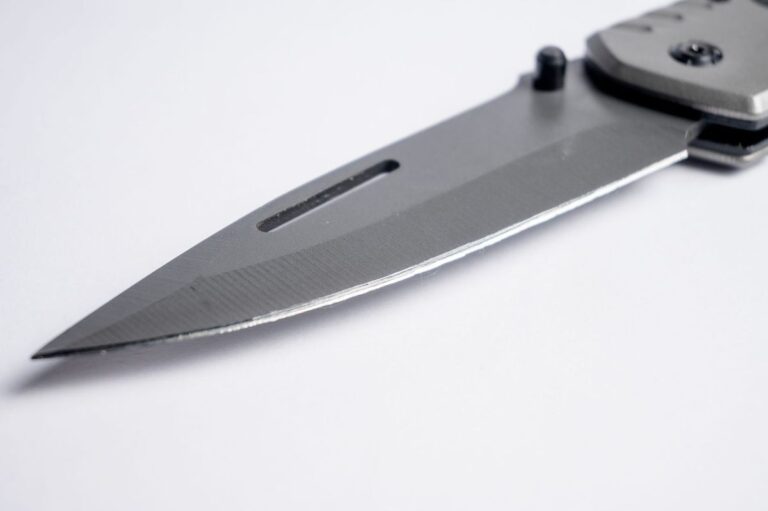
What slices cardboard, plastic, tape, and food best is a thin, keen edge — which points you toward a flat or high-flat grind (like the Spyderco Street Beat) or a full flat with a fine secondary bevel. These geometries glide through material instead of wedging it apart. A Scandi will absolutely do city work, and it’s forgiving to sharpen, but if your day is 80% slicing and 0% batoning, don’t buy geometry optimized for splitting kindling. Match the grind to the cut, not to the campfire aesthetic.
Blade length ties into this. For urban carry, four inches is the practical ceiling and most of the sweet spot sits between 2.5 and 3.5 inches. That’s long enough for real utility, short enough to stay discreet and — critically — short enough to stay legal in most cities. Which brings up the one non-spec factor you can’t ignore.
The Legal and Social Layer
A fixed blade is legally and socially heavier than a folder in a lot of places. Many jurisdictions treat fixed blades differently, restrict blade length, or ban concealed carry of any fixed knife outright — and even where it’s legal, pulling a full-tang blade to open a package in a coffee shop reads very differently than clicking open a folder. None of that is a reason to skip a fixed blade for EDC, but it’s a reason to carry a small, discreet one and to know your local rules before you clip a sheath to your belt.
This is genuinely a case where you should check your city and country’s knife laws yourself rather than trust a forum post — length limits and concealment rules vary wildly and change. When in doubt, a sub-3-inch blade carried in a way that isn’t printing on your hip keeps you well inside the sensible line in most places.
Real Models That Get the Formula Right
Put steel, tang, and grind together and a handful of knives keep rising to the top of the urban-EDC pile — each one a slightly different answer to the same problem.
The ESEE Izula II is the reference-standard small fixed blade: 1095 carbon steel, skeletonized full tang, contoured Micarta scales, and a molded sheath that carries about a dozen ways. It’s tough well past what a city ever demands, the edge is easy to maintain, and it’s cheap enough that you’ll actually use it instead of babying it. The only tax is carbon-steel upkeep — wipe it down and it’ll outlive you.
If you want stainless and value, the Morakniv Garberg is the grown-up Mora: full-tang 14C28N (or stainless Sandvik), a spine you can strike, and a genuinely useful multi-mount sheath. It’s a touch bigger and more outdoorsy than a pure city knife, but the fit and finish per dollar is unmatched — and the smaller Eldris in the same line is arguably the better neck-carry option if you want something that vanishes.
Shop Morakniv Garberg on Amazon
For the person who wants a knife designed from scratch for urban self-defense and utility, the Spyderco Street Beat — a Fred Perrin design in VG-10 with a full-flat grind and a slim FRN or G-10 handle — is about as purpose-built as it gets. The thin grind slices exceptionally, the profile carries flat, and the ergonomics are dialed for a quick, secure draw. It’s the closest thing on this list to a true city-first fixed blade rather than a woods knife on a diet.
Shop Spyderco Street Beat on Amazon
Rounding out the field: the Benchmade 200 Puukko (CPM-3V, stick tang, Scandi-ish grind) is a premium slicer for people who love the Nordic feel, and the White River M1 Backpacker (CPM S35VN, full flat, Kydex) is a superb stainless slicer if you want low-maintenance steel in a compact, city-legal package. Any of these will out-cut and out-last the folder you’re carrying now — the choice comes down to which of the three variables you weight hardest.
How to Actually Choose Yours
Skip the spec-sheet paralysis and answer three questions in order. First, how do you maintain gear? Wipe-and-forget means stainless; a little ritual means carbon. Second, what’s the hardest thing you’ll ask of it? If it’s genuinely just cutting, a skeletonized or stick tang keeps the carry slim; if you’ll pry or lean on it, go full tang. Third, where and how will it ride? That sets your blade length and sheath — and your legal ceiling. Answer those and the “best fixed blade for urban EDC” stops being a top-ten list and becomes one specific knife: the one built for the way you actually move through your city.
Buy that one, carry it every day, and keep it sharp. A fixed blade rewards commitment more than any folder does — because the whole point is that it’s always the same, always ready, and never asks anything of you but a wipe-down and an edge.
Sources
- Wikipedia — Tang (tools): full, skeletonized, and stick tang construction
- Wikipedia — Blade grind: flat, Scandi, and hollow geometry explained
- ESEE Knives — official site
- Morakniv — official site
- Spyderco — official site
Handmade Polish craftsman knives
Shop Polish Custom Knives →
We may earn a commission when you shop through our Polish Custom Knives link.