No Moving Parts to Fail: Making the Case for a Fixed Blade in Your Urban EDC
Ask most guys what a city knife looks like and they’ll describe a folder — a thumb-stud, a pivot, a pocket clip riding at 4 o’clock. Fixed blades get filed under camping, bushcraft, or something you strap to a plate carrier. That’s a habit, not a rule. A small fixed blade is the simplest cutting tool you can own: one piece of steel, no pivot to loosen, no lock to wear out, no lint packing into a detent. For a lot of urban carriers, it’s quietly the better everyday answer — you just have to size it, sheath it, and carry it like you actually live in a city instead of a treeline.
This is a guide to doing exactly that: why a fixed blade earns its keep in an urban EDC, how to pick one that carries discreetly, and how to stay on the right side of the law while you do it. No round-up ranking, no “top ten” — just the reasoning a gear-nerd actually uses before something goes on the belt.
Why a Fixed Blade Makes Sense in the City
The pitch for a fixed blade in an urban setting isn’t toughness for its own sake — nobody’s batoning firewood on a lunch break. The pitch is reliability and speed on the small, boring cuts you actually make: breaking down Amazon boxes, cutting zip ties, slicing tape, opening clamshell packaging, trimming a loose thread, prepping a sandwich at your desk. A folder does all of that too, but it asks you to deploy it first. A fixed blade is already deployed. You draw it and it’s ready — no two-handed fumble, no worrying whether the lock seated.
There’s a durability argument underneath that. A folding knife is a machine with tolerances — a pivot, a lock face, a detent ball, and (increasingly) caged bearings that hate grit. Every one of those is a point of failure and a place for pocket lint, drywall dust, or coffee to collect. A fixed blade has none of it. The tang runs the full length of the handle, so there’s no leverage point that can flex or fold. When you push hard on a stuck box or pry a staple, the knife doesn’t care. For people who want a tool they can ignore for years and still trust, the simplicity is the whole point.
The trade-off is honest: a fixed blade takes up sheath space instead of clipping flat, and it demands more thought about how and where you carry. Get that part right and the knife disappears into your day. Get it wrong and it prints through your shirt or digs into your hip until you leave it in a drawer.
Blade Length and Profile: Smaller Than You Think
The single biggest mistake in urban fixed-blade EDC is buying too much knife. A 5-inch drop point looks great on a table and lives on your dresser. The sweet spot for city carry is roughly a 2 to 3.5 inch blade — long enough to break down a box in one pull, short enough to conceal, ride comfortably, and stay under most length limits.
Profile matters as much as length. A flat or high saber grind with a fine, acute tip handles the slicing and detail work that makes up 90% of urban tasks. You don’t need a thick, spear-pointed “tactical” blade with a half-inch of belly — that geometry is built for stabbing and prying, not for cleanly opening a padded envelope. A skeletonized handle or thin scales keep the whole package flat against your body. Think slicer first, everything else second.
The ESEE Izula and Izula II are the reference point here for a reason. Roughly 2.6 inches of 1095 carbon steel, full tang, skeletonized (or micarta-scaled on the II), and near-indestructible. It’s a design that’s been carried for over a decade precisely because it hits the size and simplicity target without pretending to be a survival knife. The CRKT Minimalist takes the same idea even smaller and lighter — a tiny fingered handle and a short blade that vanishes on a neck cord.
Carry Systems: The Sheath Is Half the Knife
With a folder, the pocket clip decides how it carries. With a fixed blade, the sheath is the carry system, and it’s where most urban setups live or die. A great blade in a bad sheath gets left home. Here’s how the real options break down for city life.
Neck carry
A small blade in a Kydex sheath on a breakaway cord, riding under a T-shirt or button-up. It’s the most concealed option going — nothing on your belt, nothing in your pocket, and a fast draw straight down the centerline. The Izula and CRKT Minimalist were practically built for it. The catch: it’s a warm-layer setup. In summer with a single thin shirt, a neck knife can print or feel obvious, so it shines most under a jacket or overshirt.
Pocket sheath (deep-carry)
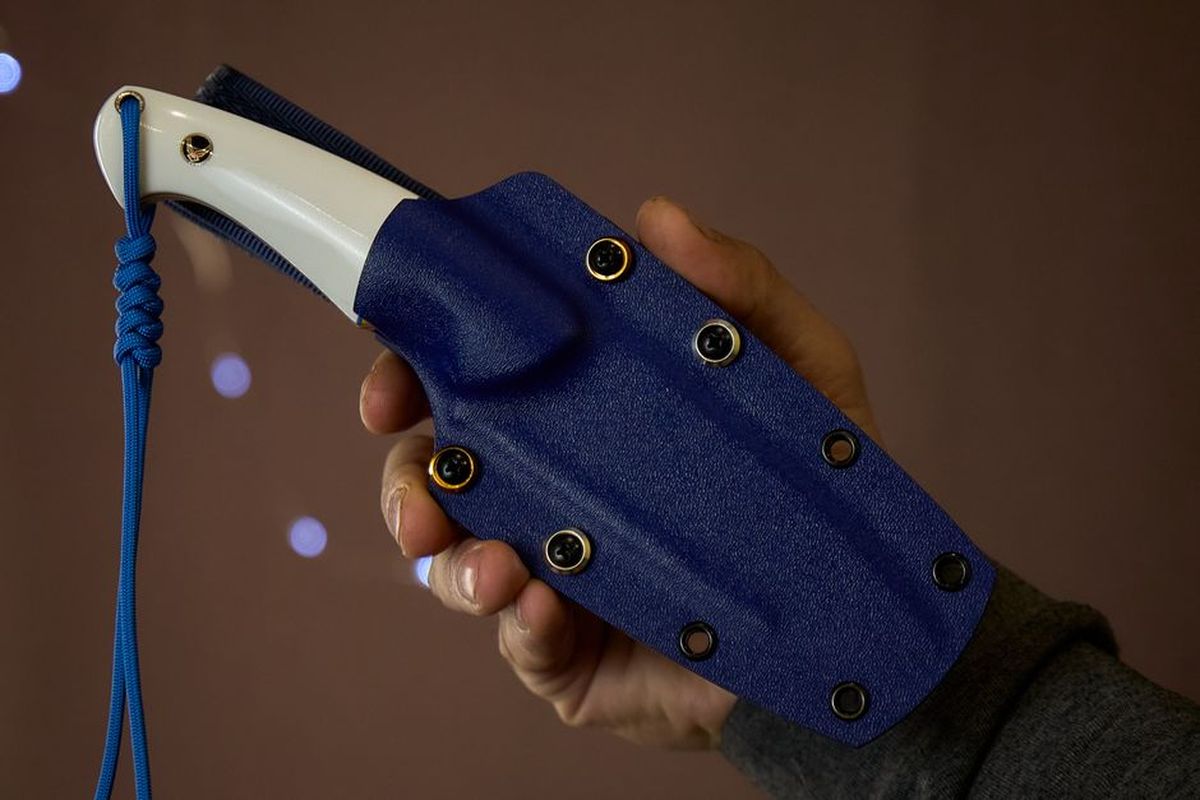
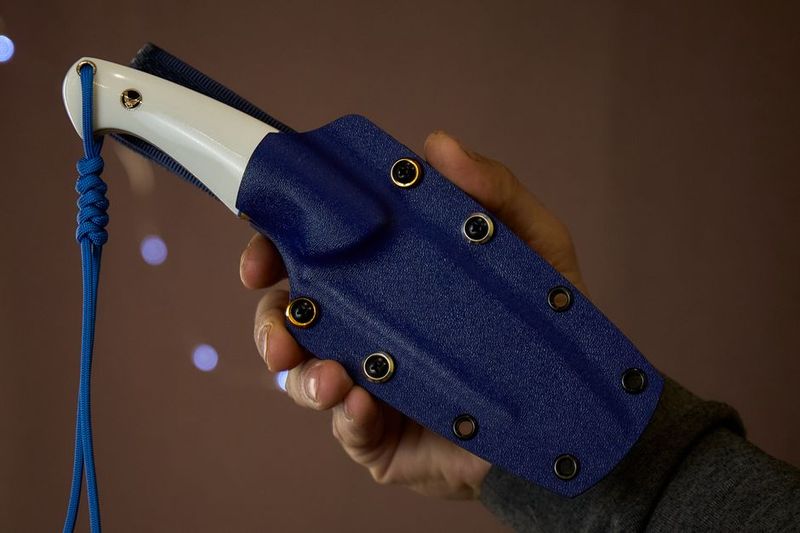
A Kydex sheath with a spring-steel clip that rides inside the waistband or drops the knife into your pocket exactly like a folder. This is the most versatile urban method — it looks and carries like a normal pocket knife, so nobody clocks it as a fixed blade at all. Brands like White River, Böker Plus, and Civivi ship small fixed blades with excellent deep-carry pocket clips out of the box. If you want a fixed blade that behaves like the folder you’re replacing, start here.
Horizontal (scout) belt carry
The sheath rides sideways along the small of your back or front of the waistband, tucked flat under an untucked shirt. It’s comfortable for all-day wear, sits under a seatbelt without jabbing you, and conceals well because it follows the beltline instead of hanging off it. The Benchmade SOCP and various KA-BAR Becker neckers adapt easily to this. It’s the setup to reach for when a neck knife is too warm and a pocket sheath is too crowded.
Whatever method you pick, insist on Kydex or a rigid molded sheath with solid retention — a snap and an audible click when the knife seats. Leather looks classy but softens, loosens, and can let a blade shift or fall out over years of daily draws. A fixed blade that isn’t locked into its sheath is a genuinely bad idea to carry against your body.
Steel: You Don’t Need a Supersteel, But It Helps
Fixed-blade EDC has a split personality on steel. On one side you’ve got traditional carbon steels like 1095 (the Izula, most Beckers) — tough as nails, dead easy to sharpen on anything, and cheap. The tax is corrosion: 1095 will patina and can rust if you carry it sweaty against skin and never wipe it down. In humid cities, that’s a real maintenance chore, not a theoretical one. A quick wipe and a film of oil keeps it honest.
On the other side sit the stainless and powder steels that make a fixed blade genuinely low-maintenance for daily wear. D2 is the affordable middle ground — semi-stainless, holds an edge well, a bit stubborn to sharpen. S35VN is the well-rounded premium standard. And MagnaCut has become the darling of the EDC world for good reason: it delivers high edge retention, real toughness, and genuine stainless corrosion resistance all at once, which is exactly the combination a body-carried urban knife wants. If you carry against skin in a humid climate and hate maintenance, a MagnaCut or S35VN blade is worth the upcharge.
Don’t overthink it, though. The best steel is the one on a knife you’ll actually carry and keep sharp. A well-maintained 1095 blade out-cuts a neglected supersteel every single time.
Shop CRKT Minimalist on Amazon
The Legal Reality of Carrying a Fixed Blade in a City
This is the part folder-carriers get to skip, and it’s the part you cannot. Fixed-blade laws vary wildly by country, state, and even city, and the rules often distinguish between open carry and concealed carry, and between blade length thresholds. In many U.S. jurisdictions a fixed blade is perfectly legal to carry openly but restricted or illegal to conceal — the exact opposite of the discreet setups this article describes. Elsewhere, any fixed blade over a certain length is a hard no in public without a specific reason.
The practical rules of thumb:
- Look up your specific state and city ordinance before you carry — a state law can be overridden by a stricter municipal one.
- Pay attention to whether the law regulates concealment, blade length, or knife type — those are three different tests and a knife can pass one and fail another.
- “Reasonable use” and “tool vs. weapon” framing matters. A small slicer with a utility profile reads very differently than a double-edged dagger in front of a judge.
- Airports, courthouses, schools, and government buildings are absolute no-go zones regardless of local law.
None of this is legal advice — it’s a prompt to do fifteen minutes of homework on your jurisdiction before you strap steel to your body. Knowing the law is part of the EDC discipline, not an afterthought.
Building the Setup: How the Pieces Fit
Put it together and a great urban fixed-blade EDC is a system, not just a knife. You’re choosing three things in concert: a blade sized under 3.5 inches with a slicing-first grind, a rigid sheath matched to how you dress (neck under layers, pocket clip for warm weather, horizontal for all-day comfort), and a steel that fits your maintenance tolerance. Nail those three and you end up with something that carries as invisibly as a folder but deploys faster and never fails mechanically.
A realistic starter setup looks like this: an ESEE Izula II or a Civivi/White River small fixed blade in D2 or MagnaCut, in a Kydex sheath with a deep-carry pocket clip, riding in the strong-side pocket exactly where your folder used to live. It looks like a pocket knife, cuts like a scalpel, and has zero moving parts to babysit. That’s the whole argument for a fixed blade in the city, delivered in a package nobody around you even notices.
The Bottom Line
A fixed blade isn’t a downgrade from a folder for urban carry — for a lot of guys it’s the honest upgrade they never tried. It’s simpler, faster, and more durable, and modern small designs conceal every bit as well as a pocket clip once you get the sheath right. The homework is real: size it down, sheath it properly, pick your steel for your climate, and know your local law cold. Do that, and the last knife you reach for on a normal Tuesday won’t have a pivot at all.
Sources
- ESEE Knives — Izula and Izula II specifications
- CRKT — Minimalist series details
- Benchmade — SOCP and fixed-blade line
- Wikipedia: CPM MagnaCut — powder steel composition and properties
- American Knife & Tool Institute — U.S. state-by-state knife law resources
Handmade Polish craftsman knives
Shop Polish Custom Knives →
We may earn a commission when you shop through our Polish Custom Knives link.