One Flick and It’s Open: How Deployment Separates the Best EDC Knives Under $100
Spend enough time on knife forums and you’ll notice something: two guys can own the exact same steel, the same lock, the same handle scales, and one carries his blade every single day while the other’s lives in a drawer. The difference is almost never the spec sheet. It’s the half-second between your thumb hitting the knife and the blade snapping into place. Under $100, deployment is where the real separation happens — because at this price the steel and the locks have mostly gotten good, but the way a knife opens still ranges from buttery to broken-in-a-week frustrating.
This is a walk through the deployment methods you’ll actually meet under a hundred bucks, what each one does well, where it fails, and the specific knives that nail it. If you’ve been buying folders by blade steel alone, this is the other half of the equation.
Why Deployment Matters More Than the Marketing Admits
An EDC knife gets used one-handed. That’s the whole point. You’re holding a box in your off hand, a leash, a phone, a coffee — and you need the blade open now, without a two-handed ceremony. A knife that requires you to stop, reposition your grip, and pry at a nail nick is a knife you’ll stop reaching for. Deployment is the interface between you and the tool, and like any interface, friction kills adoption.
There’s also the tactile reward nobody talks about openly but everyone feels. A knife that opens with a satisfying snick gets carried and fidgeted and, crucially, remembered. That dopamine hit is why the flipper-knife market exploded. It’s not just function — it’s whether picking the thing up feels good. Under $100 you can absolutely get that feeling; you just have to know which mechanism delivers it and on which knife.
The Thumb Stud: The Honest Workhorse
The thumb stud is a small post protruding from the base of the blade. You push it with the pad of your thumb, roll the blade up and out, and lock it. It’s the most common deployment method on the planet for good reason: it’s cheap to manufacture, reliable, and it works with gloves on if the stud is big enough.
The knife that defines this category under $100 — well under, actually — is the Ontario RAT 1 and its smaller sibling the RAT 2. AUS-8 or D2 steel, an oversized ambidextrous thumb stud you literally cannot miss, phosphor-bronze washers, and a price that’s stayed absurdly low for a decade. It’s not fancy. The action is more “solid” than “silky.” But it opens the same way on day one as it does after five years of pocket lint, and that consistency is the entire argument for a thumb stud.
The CIVIVI Elementum takes the same principle upmarket. Same rough price bracket, D2 blade, but with a smoother detent and a more refined pivot on caged ceramic ball bearings, so the thumb-stud roll feels closer to a flipper’s drop than the RAT’s mechanical thunk. If you want the honesty of a thumb stud with a nicer break-in, that’s the one.
The weakness of the thumb stud is geometry. If the stud sits too close to the handle or the detent is heavy, you’ll fumble it — the stud digs into your thumb pad instead of rolling the blade. It’s also slower than a flipper for most people once they’ve learned both. But for pure grab-and-go reliability, nothing has a longer track record.
Shop the Ontario RAT 1 on Amazon
The Flipper Tab: Speed You Can Feel
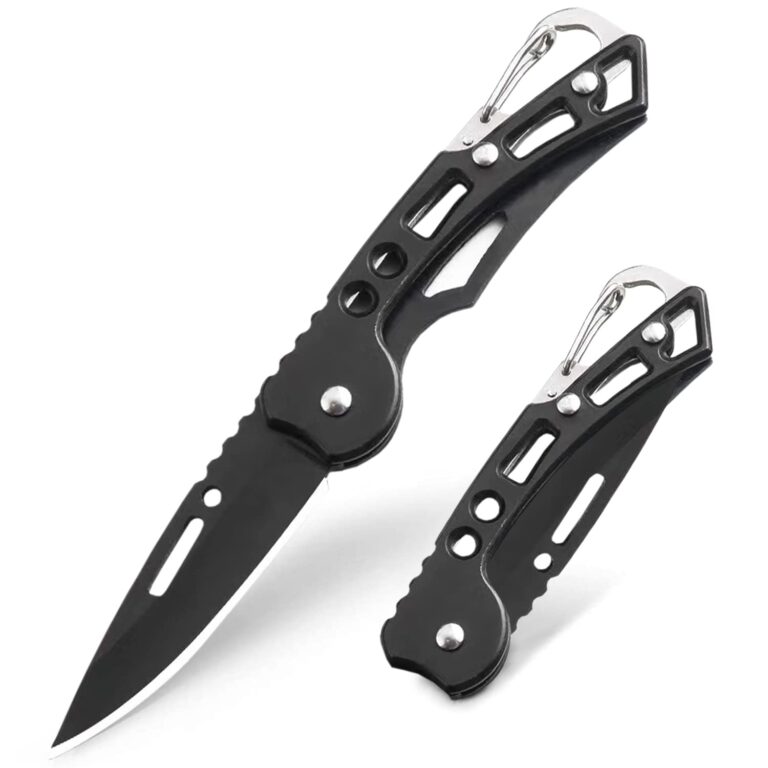
A flipper is a small tab protruding from the spine of the blade when the knife is closed. You pull it toward you (or push down), and the blade rockets open, driven by a detent ball riding along a track until it clears and the bearing action takes over. Done right, it’s the fastest, most repeatable manual deployment there is — and the one most likely to give you that fidget-toy satisfaction.
The magic word here is detent. A flipper is a spring-loaded lever, and the strength of the detent determines whether the blade flies open every time or stalls halfway (“crossing the T”). Cheap flippers with weak detents feel gummy and unreliable. Good ones — and there are plenty under $100 — have a crisp, tuned detent that gives you a consistent snap regardless of technique.
Standard flipper vs. front flipper
Most flippers are back flippers: the tab sits at the rear of the blade spine and sticks up as a small guard when open. Kizer’s Vanguard line and much of the Sencut and CIVIVI catalog live here, offering bearing-pivot flippers in 154CM, D2, or Nitro-V for $40 to $80. These are the value sweet spot for anyone who wants flipper speed without spending mid-tier money.
A front flipper puts the tab at the front of the handle, near the pivot, and you deploy it with a downward push of the index finger. It’s slicker-looking and leaves no protruding guard, but it’s fussier to learn and less forgiving with cold or wet hands. The CJRB Pyrite pairs a front-flipper-style opening with a button lock and has become a genuine cult favorite around $40 — but treat that learning curve as real, not marketing.
The flipper’s downside is the tab itself. It’s a small snag point in the pocket, and some people find the open-position guard uncomfortable in certain grips. It also demands the pivot be dialed in — a flipper with a loose or gritty pivot is worse than a good thumb stud. But when the action is right, nothing under $100 feels more expensive than a well-tuned flipper.
Shop Kizer Vanguard Flippers on Amazon
The Round Hole: Spyderco’s Quiet Genius
Spyderco’s trademark round hole in the blade — the “Spyderhole” — is deployment engineering that’s aged remarkably well. You place your thumb through the hole and rotate the blade open. Because your thumb is inside the blade rather than pushing against a small post, you get enormous leverage and a huge margin for error. It works with gloves, works wet, works when your thumb is only half-cooperating.
Under $100 this puts two knives on the table. The Spyderco Tenacious sits around $45 with 8Cr13MoV steel, phosphor-bronze washers, and a full-size hole that new users deploy correctly on the first try — the flattest learning curve of any method here. Step up to the Spyderco Delica 4, right at the $100 line, and you get VG-10 steel, a lighter FRN handle, and a legendary EDC pedigree that’s converted more people to one-hand carry than any marketing campaign.
The trade-off is aesthetic and mechanical. The hole isn’t as fast as a snappy flipper, the action is a deliberate roll rather than a launch, and some people simply don’t like the look. But for sheer reliability of access — the knife opening when you need it, however you grab it — the round hole is arguably the most foolproof system on this list.
Assisted Opening: The Spring-Loaded Middle Ground
Assisted opening knives use a torsion bar or spring that kicks in once you start the blade moving. You nudge a thumb stud or flipper past a certain point and the spring finishes the job, snapping the blade open with authority. It’s not an automatic (the blade won’t fly open from closed on its own), but it feels close.
Kershaw owns this space under $100 with its SpeedSafe mechanism. The Kershaw Leek, around $50 to $65, is the icon — a slim, elegant assisted flipper with a needle-fine tip and a snap that still surprises people who’ve never handled one. The Kershaw Blur is the beefier, grippier cousin for those who want more knife in hand. Both open with genuine speed and almost no technique required.
Two honest caveats. First, legality: assisted-opening knives are restricted or banned in some jurisdictions, so check your local laws before you carry one — this matters more here than with any manual folder. Second, the spring is a wear part and a failure point in a way a bare pivot isn’t; a manual flipper has fewer things to break. For a lot of people the trade is worth it, because nothing gets a blade open faster from a dead stop with less practice.
Shop the Kershaw Leek on Amazon
Matching the Mechanism to Your Hands and Your Day
Here’s the part the spec sheets can’t do for you. The “best” deployment is the one your hands and your environment actually reward.
If you work with gloves on — trades, cold climates, warehouse — the round hole and a large thumb stud win, because both give you a big target and forgiving leverage. A flipper tab shrinks to almost nothing under a work glove. If you’re an office carry who mostly opens mail and packages and wants that satisfying daily click, a bearing flipper is pure joy. If you want the shortest possible learning curve to hand to a spouse or a coworker, the Spyderhole deploys itself. And if raw speed from a dead stop matters and your laws allow it, assisted opening is unmatched under $100.
Left-handed carry deserves a mention too. Ambidextrous thumb studs (RAT 1) and the symmetric Spyderhole are genuinely lefty-friendly out of the box. Many flippers are ambidextrous by nature since the tab sits on the centerline, but check the clip and lock side. Assisted knives vary — some are handed. Don’t assume; verify before you buy.
Tuning What You Already Own
A deployment that feels wrong out of the box often isn’t a design flaw — it’s a factory that shipped the knife dry and over-tightened. Two adjustments fix most sins. First, loosen the pivot: back the pivot screw off in tiny increments until the blade swings freely with no side-to-side blade play, then lock it there with a drop of blue threadlocker. A gritty flipper usually just needs the pivot backed off a quarter turn.
Second, lubricate the pivot with a light knife oil or even a dry PTFE lube — not a heavy grease that attracts grit. On bearing pivots this transforms a stiff flipper into the drop-shut action the marketing promised. And break the knife in: a detent softens and a pivot smooths over the first few hundred opens. That budget flipper that felt gummy in the store may be genuinely excellent after a week in your pocket. Deployment is partly the knife and partly the miles you put on it.
The Bottom Line
Under $100, steel is rarely the reason a knife lives in your pocket or dies in a drawer. Access is. A RAT 1 will outwork knives twice its price because that giant thumb stud never lets you down. A Kizer or Sencut flipper delivers a snap that feels like a $200 knife for a third of the money. A Spyderco Delica opens for anyone, every time, in any condition. A Kershaw Leek is still the fastest cheap thrill in EDC. Pick the mechanism that matches your hands, your gloves, and your local laws — then buy the knife that executes it well. That’s the whole game at this price, and it’s a game you can win for well under a hundred dollars.
Sources
- Spyderco — official site (Spyderhole, Delica, Tenacious)
- Kershaw — official site (SpeedSafe, Leek, Blur)
- Pocketknife — Wikipedia (deployment and lock overview)
- Assisted-opening knife — Wikipedia (legality and mechanism)
Handmade Polish craftsman knives
Shop Polish Custom Knives →
We may earn a commission when you shop through our Polish Custom Knives link.