AA or 18650: The Battery Platform Decision Behind Every Great EDC Flashlight in 2026
Everyone obsesses over lumens. Max output, turbo modes, candela ratings—the spec sheet becomes the product in EDC flashlight circles. But the number that actually defines your daily carry experience isn’t on the spec sheet at all. It’s the battery format you commit to when you choose your light.
That decision—AA, 18650, CR123A, or AAA—shapes your backup plans, your charging infrastructure, your emergency options at 11pm in a rural gas station, and whether your light is still pushing regulated output after six months riding a jacket pocket. It’s the most foundational call in EDC lighting, and most buyers make it backwards: they pick a light they saw on a gear forum, then discover they’ve locked themselves into a battery ecosystem they didn’t fully understand. Reverse engineer from the battery format first, and the product choice gets substantially easier.
The Four Battery Formats EDC Flashlights Actually Use
AA, 18650, CR123A, and AAA each represent a different set of engineering trade-offs, not a different point on a single performance scale. AA bets on availability and redundancy. 18650 maximizes output and rechargeable convenience. CR123A prioritizes shelf life and cold-weather reliability. AAA compresses everything to minimum footprint. Each format is the correct answer for a different carry context—which means the question isn’t which format is best, it’s which trade-off matches your actual life.
AA: The Redundancy Argument
AA is the most universally available battery format on earth. It lives in gas stations, airport shops, convenience stores in rural Japan, and the junk drawer of every house you’ll ever visit. For EDC flashlights, that availability is a genuine operational advantage—particularly if you travel internationally, spend time in the field, or operate anywhere that charging infrastructure is inconsistent or unavailable.
The case for AA isn’t peak performance. It’s resilience. The Zebralight SC5c Plus AA runs a single AA cell and delivers up to 710 lumens on fresh lithium—enough output for most real-world tasks—while fitting in a coin pocket. Its UI uses a side e-switch with direct access to low via a half-press, which means you’re not cycling through turbo modes at 2am trying to read a label. When the cell dies, you’re never more than five minutes from a replacement anywhere in the developed world. Operating cost is higher than rechargeable, but operational redundancy is unmatched by any other format.
Shop Zebralight SC5c Plus AA on Amazon
There’s a real performance ceiling to acknowledge. Alkaline AAs have higher internal resistance than lithium-ion cells, which limits how much current you can push through the driver circuit. AA-powered lights generally top out below 1000 lumens in sustained real-world use, even when the spec sheet claims higher—the voltage sags under load, regulation drops, and output falls. Energizer Ultimate Lithium AAs close that gap significantly and perform far better in cold temperatures than alkaline chemistry, but you’re still not reaching 18650 performance territory on a single cell. That tradeoff is the deal: you’re buying insurance, not horsepower.
The Streamlight ProTac 1L-1AA takes a hybrid approach worth noting: it accepts either a CR123A lithium primary or a single AA, trading optimized output for format flexibility. For a pocket light that might sit unused for months in a bag or console, that redundancy is more valuable than peak lumens. The ProTac’s momentary-on tail switch is one of the better tactical interfaces in its price class, and the dual-format capability means it survives supply chain problems in ways that single-format lights don’t.
18650: The Performance Standard
If you’re serious about EDC lighting performance, 18650 is the format most flashlight engineers design around. The lithium-ion chemistry allows high continuous discharge rates, and the capacity—typically 3000–3500mAh in quality cells from Panasonic, Samsung, or Sony—enables regulated output at meaningful lumen levels for durations that actually matter in field use. The format is large enough to house real thermal management, which is why you see temperature step-down features in 18650 lights that simply don’t appear in AA designs.
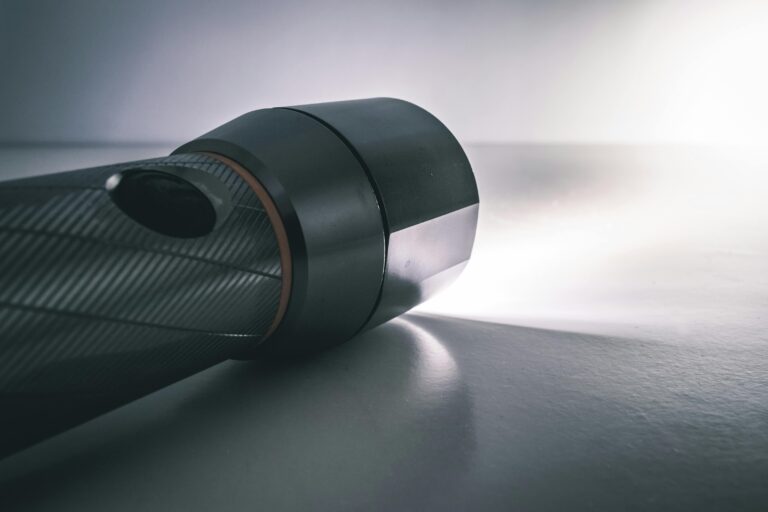
The Olight S2R Baton III shows what 18650 makes possible in a compact EDC form factor: 1200 lumens max output, magnetic USB-C charging built directly into the light body, and a side-switch plus tail-switch UI that’s genuinely one-hand operable in the dark. The side e-switch gives access to moonlight mode without hunting through a sequence. Its magnetic charging tail means no exposed charging port—the tail sits flush with no cap to lose—and the light can charge standing upright on a magnetic surface. That combination of high ceiling and practical daily usability is what separates it from high-spec tubes that are painful to live with.
Step up in cell size and the Fenix PD36R Pro enters 21700 territory: the same cylindrical form factor as 18650 but 70mm long instead of 65mm, with higher capacity and 2800 lumens peak from a light that still carries flat in a jacket pocket. Fenix includes an 18650 adapter in the box if you want battery format flexibility without buying a second light—a thoughtful spec decision that acknowledges not everyone is ready to commit fully to 21700 infrastructure. The PD36R Pro’s built-in battery level indicator, a small readout on the body, is the kind of practical feature that separates working tools from lights that look good in spec comparison threads.
Shop Olight S2R Baton III on Amazon
The infrastructure obligation for 18650 is the flip side of the AA availability argument: when your cell depletes, you’re charging it, not replacing it. That means planning—a charged spare, a cable, access to power. In a daily routine, this is trivial. On a backcountry trip or in a grid-down situation, it’s a genuine liability. Every 18650 carry is implicitly a bet that you’ll be near power before you hit critical need. Most people win that bet every day. Not everyone does, in every context.
CR123A: The Shelf-Life Case
CR123A is a lithium primary cell—non-rechargeable, high energy density, and the battery format Surefire built its entire commercial product line around. The argument for CR123A in EDC isn’t performance per dollar (where 18650 dominates) or point-of-need availability (where AA dominates). It’s shelf life and cold-weather operational reliability in environments where the other formats fail quietly.
CR123A cells carry a 10-year shelf life from reputable manufacturers. They maintain voltage at temperatures that cause lithium-ion cells to sag badly—tested to -40°F in military-spec cells. The Surefire G2X Pro is the accessible civilian entry point into that ecosystem: a glass-filled nylon body built to MIL-SPEC drop and temperature ratings, 600 lumens on high with a regulated constant-output circuit, and the kind of switch reliability that defines Surefire’s reputation. Load it with fresh Surefire or Panasonic CR123As, put it in a vehicle emergency kit, and it will run exactly to specification two years from now without you touching it again.
Shop Surefire G2X Pro on Amazon
The weaknesses are cost and point-of-purchase availability. Two CR123As in a dual-cell light cost roughly what four quality AAs cost, and finding them at a non-sporting-goods retail location at 10pm is hit-or-miss. For a purse light or car kit that sits untouched for six months, CR123A earns its cost premium. For a pocket light you’re cycling daily, the economics and inconvenience don’t pencil out. Match the format to the use case.
The Charger Infrastructure Problem Most Buyers Underestimate
Single-18650-light users rarely hit the charger problem. One light, one dedicated charger, one spare cell—a manageable three-piece system. The complexity compounds when you’re running multiple 18650 lights: a daily pocket carry, a bag or desk light, and a vehicle or nightstand backup. Suddenly you’re managing four or five cells on a rotating charge schedule, and if any one of them is depleted at the wrong moment, you reach for a light and find it dead.
Lights with USB-C charging built into the body—Olight’s magnetic tail system and Fenix’s internal charging port both handle this well—partially solve the problem by letting you charge without handling loose cells. The tradeoff: the light is unavailable during charging unless you own a duplicate. Dedicated multi-bay chargers, like the Nitecore UMS4 which monitors and charges four cells simultaneously with individual bay status, solve the infrastructure problem properly once you’ve committed to the 18650 platform—but they’re an additional acquisition and a piece of gear to manage on a nightstand or shelf.
AA users carry none of this overhead. Keep a pack of Energizer Ultimate Lithiums in the bag and the charger question doesn’t exist. That simplicity has real value if you’re equipping a kit that other people—a partner, a kid, anyone who doesn’t want to manage battery logistics—need to use without understanding cell rotation. Infrastructure transparency is an underrated spec.
How Your Actual Carry Pattern Resolves the Question
The right battery format follows from how you actually carry, not from what performs best on paper. If you commute daily in an urban environment, charge gear on a nightstand every night, and your emergency scenarios look like power outages in a city where hardware stores are open by morning, 18650 is probably your format. The charging infrastructure is there, the performance ceiling is real, and the inconvenience of not being able to walk into a pharmacy for a replacement battery is zero.
If you travel internationally for work—particularly through regions where power reliability varies—or you want a light that functions as a genuine emergency tool with no charging dependencies, AA gives you operational security that no performance spec can replicate. Pair a Zebralight SC5c Plus with a blister pack of Energizer Ultimate Lithium AAs and you have an EDC light that works in a blackout in any country on earth, in any season, without a cable or a charger in sight.
If your primary EDC flashlight lives in a vehicle emergency kit, a go-bag, or a cache you don’t touch for months at a stretch, the CR123A shelf-life argument is the most serious one in this comparison. Surefire built its commercial reputation on exactly that use case, and the engineering behind their lights—switch reliability, regulated output, thermal robustness—reflects decades of designing for exactly the moment when a flashlight has to work and there’s no second chance.
None of these formats is wrong. Each is the right answer to a different set of real conditions. The mistake is choosing based on peak lumens when the actual question is: what happens when this light needs to work, and have I set up a system that guarantees it does? Answer that first, and the product decision becomes straightforward. Everything else is details.
Sources
- Zebralight — SC5c Plus AA product specifications
- Olight — S2R Baton III product documentation
- Fenix Lighting — PD36R Pro specifications and compatibility
- Surefire — G2X Pro product lineup and specifications