The Fixed Blade Urban Carry Test: Profiles, Sheaths, and the Knives That Pass
Most fixed blade knives are designed with wilderness in mind — the assumption baked into their geometry, their steel choices, their sheath systems. A quiet shift has been happening in EDC circles: guys in cities are reaching for fixed blades as primary carry tools, not emergency backup pieces. The reasons are practical. No pivot pins, no lock faces to wear down, no liner springs that eventually fatigue. A fixed blade you trust is always going to be as ready as the last time you drew it. But the market is flooded with knives that work fine in camp and fail you in the city — blades too long for local law, sheaths built for belt loops on field trousers, steel that rusts without care. Sorting the genuine urban-capable fixed blades from the rest takes work on the specs. Here is where to start.
What Urban EDC Actually Demands From a Fixed Blade
The first filter is blade length. Most urban knife laws worldwide sit in the 3-to-4-inch zone, with several major cities coming in tighter — some jurisdictions cap concealed blade length at 2.5 inches. The answer for most city carriers is a blade in the 2-to-3-inch range: enough cutting surface for real work, short enough to stay out of legal grey zones. A blade that passes the length check but runs a saber grind is going to feel stubby and underpowered for utility cuts. A thin hollow or flat grind at that length punches well above its visual size.
The second filter is carry system. Urban fixed blades that disappear tend to run either horizontal belt carry, appendix-style, or around the neck. The neck knife configuration is the most concealable: worn under a shirt, it deploys faster than any folder once you have the draw motion dialed. The problem is most neck sheath designs are afterthoughts — flimsy retention, nothing that keeps the knife from shifting if you move fast. The sheaths on serious urban fixed blades are either Kydex with a retention click or formed polymer that holds edge-to-body while keeping the blade accessible on demand.
The third filter is corrosion resistance. City environments pile on the abuse that most knife steels do not expect: sweat, rain, humidity from air conditioning, whatever is in your bag pressing against the blade for eight hours. Carbon steel blades like 1095 are tough and easy to resharpen, but they develop surface rust fast in damp conditions without oiling. Most of the urban-oriented fixed blades that have earned consistent trust run either a tool steel with improved corrosion resistance or a proven stainless like S30V or VG-10 that handles moisture without requiring daily maintenance.
The Izula Profile and Why It Became the Urban Benchmark
The ESEE Izula II is, functionally, the stress-test case for what urban fixed blade carry looks like when done right. ESEE built it around a 2.63-inch blade in 1095 high-carbon steel, powder-coated to slow corrosion, with a skeletonized full-tang body that functions as the handle until you add optional micarta or G-10 scales. With scales installed, the Izula II comes in just under 3 ounces. The blade geometry is a drop point with a flat grind, which cuts cleanly through cardboard, rope, strapping tape, and the general utility work that makes up the vast majority of daily knife use. There is no special purpose here — a competent worker in a package that disappears under a t-shirt.
The stock neck sheath is stiff Kydex with a split-ring attachment. Worn on a bead chain, the Izula II tucks against your sternum and stays quiet. Retention is tight enough that you need a deliberate pull to draw it — exactly what you want in neck carry. Not so stiff you cannot get it when you need it, not so loose it shifts during movement. One practical note: 1095 steel needs attention in wet climates. A light wipe with gun oil at the end of the day takes 20 seconds and keeps the blade clean. If that maintenance cadence sounds unsustainable, seek a stainless variant in the same size class — but the powder coat on the Izula buys meaningful corrosion resistance over bare carbon steel and extends the interval considerably for casual city use.
CRKT Minimalist: The Accessible Urban Fixed Blade Entry Point
The CRKT Minimalist, designed by Alan Folts, occupies a different position in the urban fixed blade landscape. The blade runs 2.125 inches in 5Cr15MoV stainless steel — shorter than the Izula by nearly half an inch, in entry-level stainless that handles moisture without worry. At this blade length and workload, the metallurgy is sufficient. You are cutting tape, breaking down boxes, scoring packaging. The Minimalist’s real advantage is its blade profile: a wharncliffe shape with a flat cutting edge running straight to a squared-off tip maximizes usable edge at minimal overall length. On a two-inch blade, that geometry matters considerably — you recover cutting surface that a drop point profile would otherwise waste at the tip.
The handle texture is ridged enough to maintain grip purchase even wet, and the full knife-plus-Kydex-sheath package runs about 2.6 ounces. At a retail price typically under $40, the Minimalist gives urban carriers a way to test neck knife carry before committing to a higher-end piece. The tradeoff is real: 5Cr15MoV steel will not hold a working edge through sustained cutting. For daily light use it is adequate. For anything approaching sustained food prep or field-style cutting, you will resharpen frequently. Know what the knife is for and it will not disappoint.
Shop CRKT Minimalist on Amazon
Benchmade Hidden Canyon Hunter: Premium for the Urban Carry Long Game
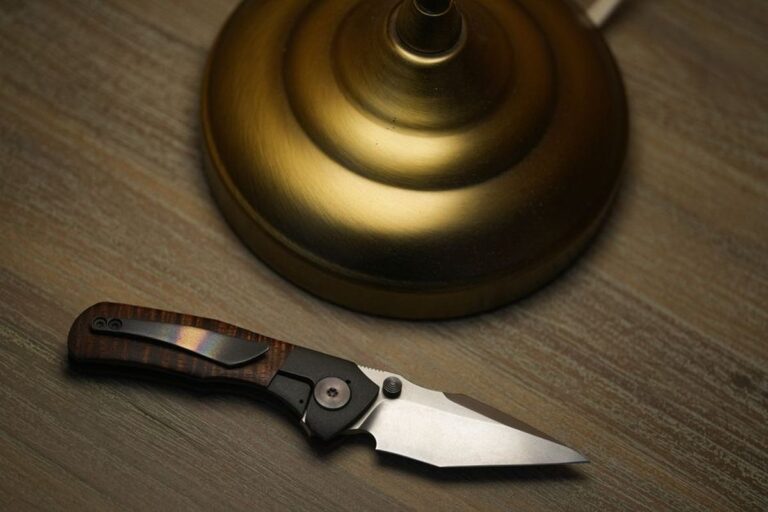
The Benchmade Hidden Canyon Hunter represents what happens when a major American manufacturer applies production tolerances and premium blade material to a compact urban carry package. The model 15060 runs a 2.67-inch blade in S30V stainless — the same specification Benchmade uses across much of its production line. S30V is a particle metallurgy stainless developed specifically for cutlery applications: it holds an edge significantly longer than 5Cr15MoV or even VG-10, resists corrosion well, and responds to ceramic rod touchups in the field without needing a full bench session. The grind is a flat hollow, keeping the blade thin behind the edge even at this compact length.
The handle is stabilized wood scales over a skeletonized stainless tang — material that adds visual character without adding carried weight. The Hidden Canyon runs about 2.75 ounces. Its Boltaron sheath uses a tension-adjustable ball-detent retention system that gives a clean click on draw and does not loosen with daily wear. The carry clip is reversible for left or right hip carry. Where the Hidden Canyon earns its premium is in sustained daily use: the blade does not start to drag after a week of moderate cutting work. You can run several months of daily light EDC use before a sharpening stone is needed. For a city carrier who wants one knife that handles shipping boxes and camping weekends without second thoughts, the edge retention justifies the price difference over budget alternatives.
Shop Benchmade Hidden Canyon Hunter on Amazon
Carbon vs. Stainless — The Urban Carry Argument
The carbon versus stainless debate lands differently in urban carry than in wilderness or tactical contexts. In field use, 1095 high-carbon makes sense: easy to bring back to sharp on a flat stone, tough enough to handle abuse without chipping, with a working edge that performs well in sustained cutting tasks. In the city, the use case is different. You are carrying a knife for hours in a sweaty gym bag, then in your pocket during a rainy commute, then clipped inside your waistband in an air-conditioned office. That environmental swing — moisture, sweat, variable temperature — is exactly where carbon steel demands active management.
Stainless in urban carry is the low-drama choice. S30V, VG-10, and even mid-tier AUS-8 handle daily urban moisture without rusting between uses. The edge performance gap that matters enormously at 4-inch blade lengths matters considerably less at 2.5 inches, because at that length you are doing light-duty work where any reasonable alloy is adequate. The specification choice reopens once you push past the $80 to $100 price point: at that level, you can access stainless alloys that also hold a serious working edge through sustained use. Below that threshold, the argument is largely about corrosion resistance rather than cutting performance — and stainless wins that argument without contest in city environments.
Sheath Systems and Why They Decide Carry Success
The knife is only half the carry equation. An urban fixed blade that fails its sheath test does not get carried. The sheath requirements for urban carry differ meaningfully from field or tactical applications, and most knives ship with sheaths designed around the wrong priorities.
Horizontal carry rigs — where the blade sits perpendicular to your belt rather than vertical — work particularly well in seated positions. Driving, desk work, and transit seating all become uncomfortable when a vertical sheath digs into your hip. Horizontal Kydex setups ride higher and flatter. The draw angle takes some practice, but comfort across a full work day is noticeably better. Several aftermarket sheath makers produce horizontal carry rigs for common fixed blade profiles including the Izula and Mora Companion, and fitting a better sheath to a solid budget knife is often the most practical upgrade available.
Neck carry is the highest-concealment option, but it demands a sheath that stays body-positive: the knife needs to hang muzzle-down, snug enough not to flip when you move, with enough clearance for a clean one-hand draw. Kydex neck sheaths with adjustable retention are the standard. The designs that fail are usually injection-molded plastic units bundled with budget knife packages — they loosen after a month of daily wear and start shifting orientation at the worst moments. Upgrading the sheath on a solid budget fixed blade is almost always money better spent than buying an entirely new knife. The knife can be right and the system can still fail; the sheath is where most urban fixed blade setups actually break down.
Matching the Fixed Blade to Your Actual Urban Carry Situation
An urban fixed blade is a commitment in a way that a folder is not. You are choosing a knife system — blade plus sheath plus carry position — and you are going to wear that system daily until it either fails or becomes invisible habit. The selection process should work backward from your actual urban context: what are your local blade length laws, how much concealment do you need, and how much maintenance will you realistically sustain?
At the budget end, the CRKT Minimalist gives you a functional entry point under $40. The neck carry system is included, the blade length keeps you legal in most jurisdictions, and the stainless handles light daily use without rust concerns. It answers whether neck carry works for your body type and clothing before you invest further. The ESEE Izula II is the tested benchmark in the mid-range: heavier and longer than the Minimalist, which means it handles more real work, but it demands more concealment management and the 1095 needs periodic oiling. The carry system is better-designed from the factory, retention is more positive, and the knife will outlast any reasonable period of daily use without meaningful degradation.
At the upper tier, the Benchmade Hidden Canyon Hunter is the knife you stop thinking about. The S30V blade extends edge-maintenance intervals, the sheath system is carry-ready out of the box, and fit and finish are at a level where daily carry builds confidence rather than prompts doubts. If you have already established that fixed blade urban carry works for your situation and want a piece that does not ask for anything, this is where the investment makes sense. The urban fixed blade market is smaller than the folder market — which means fewer mediocre options survived to production. The knives that carry credibility in city EDC circles have earned it through sustained daily use, not marketing copy.
Sources
- ESEE Knives — Official Site
- Benchmade — Official Site
- CRKT — Official Site
- Wikipedia — Knife Legislation by Region