
The Outside-Access Test: How Sub-$100 Multitools Earn Their EDC Slot
Buy a multitool, leave it in a drawer. That’s the cycle most people run, and the problem isn’t that multitools are useless — it’s that the wrong ones make you work too hard to reach a single tool. You need pliers, so you unfold the handles, deploy the head, lock everything into place. By that point you’ve already gone looking for a regular pair of pliers. Outside-tool access breaks that cycle, and at the sub-$100 price point, it’s the one design decision that determines whether a multitool becomes part of your daily carry or a glorified emergency kit sitting in your center console.
What Outside Access Actually Means
Outside-accessible tools deploy without opening the handle. They work like a folding knife — one-handed, fast, no need to unfold the whole unit. On the Leatherman Wave+, the most widely carried example at this price point, the partially serrated blade, straight blade, and diamond file all open outward from the handle halves. You access them the same way you’d open a pocket knife: thumb on the nail nick, flick, deployed. The pliers are still inside, but the tools you reach for in the first five seconds of any task are right there without a second thought.
This matters because a multitool’s value is inversely proportional to its friction. The moment reaching for a specific tool costs more effort than reaching for a dedicated tool, the multitool loses the argument. Outside access doesn’t just add convenience — it removes a decision point entirely. The knife is where a knife should be. You don’t have to think about it, and that’s exactly the point.
The Benchmark: What the Leatherman Wave+ Actually Gets Right
The Wave+ has occupied the center of the sub-$100 multitool conversation for years because it does outside access without sacrificing tool count. You get 18 tools total, but the four most-reached-for ones — two blades and a file on the outside, plus the full plier head when you need it — are all fast-access. The 420HC steel isn’t exotic, but Leatherman’s heat treat makes it perform well past what the spec sheet suggests, and the straight blade geometry is genuinely practical for cutting rather than being a decorative afterthought bolted onto a tool that’s really about the pliers.
At around $85, the Wave+ also brings spring-action pliers, which changes the plier experience significantly from cheaper alternatives. Without spring action, repeated plier work fatigues your hand fast. With spring action, the jaws open automatically and you’re only applying closing force. That single feature justifies the Wave+ over the Leatherman Rebar — a solid budget alternative at around $50 — if you plan to actually use the pliers under sustained load. The Rebar has outside-accessible blades and solid construction, but it skips the spring action, and you feel that difference within the first twenty minutes of wire work or any task that requires repeated gripping.
Shop Leatherman Wave+ on Amazon
The Stripped-Down Argument: Leatherman Skeletool
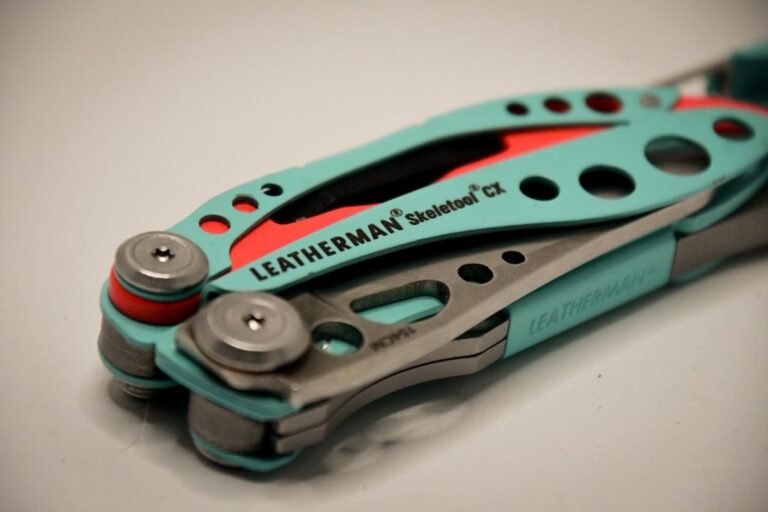
The Skeletool represents a fundamentally different philosophy about what a multitool should be. Where the Wave+ gives you 18 tools, the Skeletool gives you seven: pliers, wire cutters, knife, combination screwdriver, bit driver, carabiner clip, and bottle opener. That’s it. But those seven tools cover the majority of calls you’ll actually make, and the Skeletool’s design makes each one faster to access and more comfortable to run than a heavier, tool-stuffed unit where most of the contents never see daylight.
The knife blade sits outside the handle and deploys cleanly one-handed. The bit driver is the dominant internal feature — a center-mounted 1/4-inch driver that takes standard hex bits and positions them inline with your hand, which is how screwdrivers are supposed to work. At around $65, the Skeletool is nearly two ounces lighter than the Wave+, and the carabiner clip means you can run it on a belt loop without dedicating a sheath slot to it. If your primary EDC already includes a dedicated pocket knife and you want a compact tool supplement rather than a second blade, the Skeletool is the honest answer — you’re not paying in weight and bulk for capabilities you leave folded away.
The trade-off is real and immediate. No file, no saw, no scissors, no can opener. If you regularly need those tools, the Skeletool will frustrate you before the end of your first week. But if you’ve been carrying a Wave+ for two years and find yourself reaching for the knife and bit driver 90% of the time, the Skeletool is a legitimate case study in not carrying weight you’re not actually using. The Skeletool works best as a companion to a dedicated folder, not as a replacement for one.
The Driver-First Approach: Gerber Center-Drive
Gerber built the Center-Drive around a single insight: the most-used tool in most multitools is the screwdriver, and traditional multitool design makes you use it wrong. Standard-position bit drivers on a folded multitool put the drive axis off-center from your hand — you’re torquing at an angle, which kills efficiency and feel on anything that requires real torque. The Center-Drive puts a full-sized bit driver on the center axis of the tool, running inline with your grip, exactly the way a dedicated screwdriver works. It’s a simple mechanical insight that took longer than it should have to appear in a mainstream multitool.
The result is that the Center-Drive’s screwdriver function is noticeably better than any other multitool at this price point. It takes standard 1/4-inch hex bits, opens one-handed from the outside of the handle, and drives with real mechanical authority on fasteners that would spin out under an off-axis driver. The outside-accessible blade runs a drop-point 420HC profile with aggressive jimping that gives you genuine grip under wet or dirty hands. At around $80–90, you’re paying specifically for that driver experience — and if fasteners are the primary reason you carry a multitool, the Center-Drive solves a problem the Wave+ and Skeletool both sidestep.
The one practical limit: bit swapping requires the handles to be open, which adds a step if you’re rotating between Phillips and Torx repeatedly under time pressure. That’s a real friction point in high-repetition driver work, but in the field — adjusting straps, tightening mounts, handling incidental fasteners — it’s rarely an issue. Know your use case before deciding whether it matters to you.
Shop Gerber Center-Drive on Amazon
Plier Head, Handle Length, and What Real Leverage Feels Like
The plier is the heart of any folding multitool, and handle length is what determines how useful those pliers are under actual load. More handle equals more leverage — basic physics, but easy to lose sight of when you’re comparing product photos. The Leatherman Surge, which runs at the top of the sub-$100 window around $90–100, is bigger and heavier than the Wave+, but that size translates to noticeably better mechanical advantage when you’re gripping hard, pulling wire, or working in confined mechanical spaces. The leverage difference is felt immediately, especially on anything that requires sustained clamping force or precise jaw control on a small component.
The Surge also brings larger blades and a tool bay that accepts optional bit extenders, giving you reach into deep fastener recesses that shorter drivers can’t hit. The trade-off is size: the Surge doesn’t pocket-carry in any conventional sense and won’t sit comfortably in a front jeans pocket without printing through the fabric. It’s a belt-carry or bag tool by design. If your EDC context is a trade environment or workshop setting where the multitool comes out of a belt holster twenty times a day, that bulk is a non-issue and the Surge’s plier quality justifies its place in the lineup. If you’re carrying in an urban context and the tool needs to disappear into dress pants, the Surge is the wrong answer regardless of how good the pliers feel in your hand.
Blade Steel, Lock Mechanisms, and the 420HC Reality
Most sub-$100 multitools run 420HC steel on the blade. It’s not exotic — you won’t see it headlining blade steel discussions on gear forums — but it’s a pragmatic choice for a tool that sees water, grit, salt, and solvents on a rotating basis. 420HC takes an edge adequately, sharpens quickly on a ceramic rod or a diamond file, and resists corrosion better than higher-carbon alternatives that hold a finer edge but stain and pit faster in real carry conditions. Leatherman’s heat treat elevates the material: their 420HC performs meaningfully better than the same spec’d steel from brands that don’t invest as heavily in the process, and the difference in edge retention after a few months of real use is noticeable to anyone paying attention.
Lock mechanisms on outside-access blades matter more than most buyers account for. The Wave+ uses a liner lock on its outside blades — reliable, one-hand-closeable with practice, and resistant to the lateral pressure that causes some locking systems to partially disengage under hard use. The Skeletool uses the same system. Both lock and unlock cleanly after a short break-in period. If you’re planning to use the multitool blade as a primary cutting tool rather than a backup to a dedicated folder, how that blade locks and closes is a daily usability question, not a secondary specification to skim past on the product page.
Carry Format and Where Outside Access Actually Pays Off
Outside access only solves the deployment problem if the multitool is actually on your body. A Wave+ in a nylon sheath on your belt is faster than a Skeletool at the bottom of your bag. But a Skeletool clipped to a belt loop is faster than either one in a sheath you have to unbuckle first. The carry format question is inseparable from the outside-access question — a tool sitting in a bag or a glove compartment has no outside-access advantage at all. The feature only pays off when the tool is physically reachable in the same motion as reaching into your pocket.
The Skeletool’s carabiner clip is purpose-built for the EDC context where you want the multitool accessible without committing a full belt slot to it: clipped to a belt loop, a D-ring on a bag strap, or webbing on a pack’s front panel. The Wave+ and Surge come with nylon sheaths that work reliably but require a dedicated belt position. If you’re already running a knife, a light, and a wallet on your belt, adding a multitool sheath is a real carry decision that changes how your kit hangs and moves throughout the day. The Skeletool’s clip solves that space problem directly.
Pocket carry is the remaining variable. The Wave+ fits in a front jeans pocket but it’s felt — there’s no hiding 8.5 ounces in a standard denim pocket. The Skeletool at 5 ounces pockets without drama and doesn’t noticeably affect how your pants sit. The Surge doesn’t pocket-carry at all; it’s a belt or bag tool by every practical measure. Nail down your carry context before you buy, because outside access is a feature worth prioritizing, but it only matters when the tool actually makes it onto your body every day. The best multitool under $100 is the one you have on you when you need it — and carry format is the variable that makes or breaks that consistency.
Shop Leatherman Skeletool on Amazon
Sources
Further reading and product reference:
- Leatherman — Official product specifications for the Wave+, Skeletool, Surge, and Rebar
- Gerber Gear — Center-Drive design documentation and full tool specifications
- BladeForums — Long-term community reviews and multitool comparisons